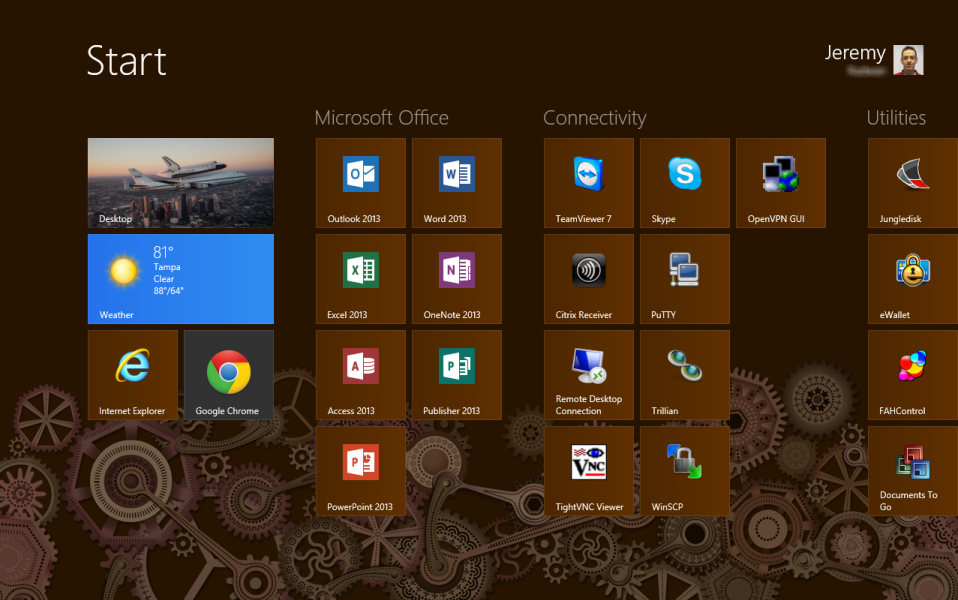
Windows 8 RTM … accepting the inevitable


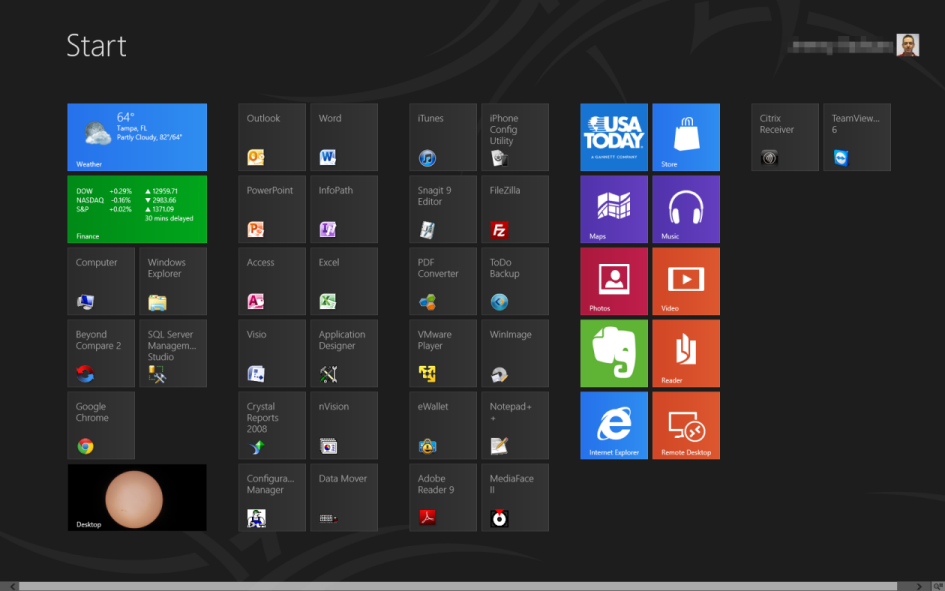
A few weeks ago we got the Windows 8 RTM at work and started installing and upgrading the operating system on our IT machines to get a jump on learning our way around Microsoft’s latest OS before rolling it out to the rest of the office.

I’ve been using the Consumer Preview of Windows 8 on my main machine at work since it was released back in March and while the final RTM version is faster and slightly more polished, not much has changed since the CP, including the fact that I’m still not enamored with Microsoft’s latest desktop offering.

Read more

Windows 8 Consumer Preview

When Microsoft released the Developer Preview of Windows 8 last fall, I played around with it a briefly in a virtual machine but tired of it quickly. Well, now that the Consumer Preview is available for download I decided to give it a serious shot and get a jump on learning my way around Microsoft’s upcoming OS. For the past week I’ve been using it as my main OS at work and here are some of my observations.

Read more

Windows 8 Developer Preview released

This week at the Build Conference, Microsoft released a freely downloadable developer preview of Windows 8 (you can download the ISOs here). If you’re an avid reader of this blog (and which of the five of you aren’t? ;-)) you know I like to jump on new technology early so of course I downloaded the 64-bit version and installed it in a virtual machine via VirtualBox.

Read more

Acer Aspire Revo 3610

My Dell OptiPlex Linux server was getting louder and hotter in its old age. For the past three years it has been running 24×7 as my media server in the closet. The fan in the power supply had started to whine (especially when the CPU was maxed), and I already lost one hard drive to a crash earlier in the year. I decided it was time to replace it and started looking for smaller, quieter, more power-efficient alternatives.

I call this box a server because it hosts this blog, a small Gallery site, some home media applications for my TiVos, and is running all the time, but I don’t need a server-class machine. My past Linux machines have traditionally been older desktops, even a laptop! So the latest crop of nettops seemed like an ideal solution.

After researching products like the Asus EeeBox, the MSI WindBox, and even the Dell Studio Hybrid I decided on the Acer Aspire Revo 3610. This little box packs in Intel’s dual-core Atom N330  CPU (1.60GHz), 2gb of RAM, nVidia’s ION graphics chipset, and a 160gb hard drive. Peripherals and storage can be connected via the 6 USB ports (one of which is used for the included wireless keyboard a mouse), the eSATA connector, and the SD card reader, and network connectivity includes a gigabit network connection and B/G/N wireless. The Revo has no optical drive, but experience with my EeePCs has made me comfortable with booting/installing from other removable media like USB thumb drives, so no biggie there. Also, since I’m not using the Revo as an HTPC I won’t be using the HDMI or digital audio (SPDIF) connections, but they’re there. The Revo comes with Windows 7 Home Premium pre-installed (although I wish Acer sold a cheaper version without it). If you’re going to use it as an HTPC it comes with a mounting plate so you can attach it right to the back of your HDTV.

My plan was always to put the latest version of Ubuntu on the box. Warranties be damned! After unpacking my new Revo, before even turning it on, I immediately cracked it open, thinking I would make an image backup of Windows 7 just in case (since it comes without a rescue disc). Unfortunately, even with my lack of fear for warranty-voiding, removing the hard drive involved more steps than I was willing to take. So rather than wiping the drive and starting clean, I booted Windows 7, did some initial setup, and then shrunk the primary partition so I could dual-boot Windows 7 and Ubuntu. Considering the current server only had a 30gb hard drive in it (and most of my media is on external NASes), having a 60gb partition for Ubuntu was acceptable to me.

Installing Lucid Lynx didn’t go as smoothly as I anticipated, however. The 64-bit version (imaged onto a 2gb USB stick) wouldn’t even boot correctly and the 32-bit version would start and then complain it couldn’t find the CD-ROM. After figuring out how to manually boot the installer from the command-line, I found this blog post that helped me get through the rest of my installation issues. Shortly, I had my Revo set up as a 64-bit Linux server!

It took me a few days to get everything transferred from the old server to the Revo and then get everything set up and configured the way I wanted. So far I am very impressed with the Revo. It’s very quiet, even when both cores are busy (i.e., folding a work unit and transcoding a video file), and my UPS utilization dropped from 29% to 10%! That’s a serious cut in power consumption. I have noticed a slight performance decrease over the old Pentium 4 Dell, but nothing major and it was expected. It’s well worth the trade-off for the reduced noise and power usage, though!

Out with the old, in with the new!

It was time to upgrade

March 1 is quickly approaching and starting Monday, people who are still running the Release Candidate of Windows 7 will start seeing the expiration message. I’ve been running the RC at home since May of last year and knew this time would eventually come, so this past week I purchased the Home Premium upgrade media from Amazon along with some extra RAM for my Dell Inspiron 530 (it had two 512mb chips that I pulled and replaced with two new 1gb chips to bring it up to 4gb total).

Based on my previous experience with the Windows Easy Transfer utility, I used WET to backup my documents and settings to an external hard drive. To be doubly sure I didn’t lose anything, I also just copied my entire user profile folder (C:\Users\<my login>) to the same hard drive. I wanted to do a clean install with the upgrade media (and also go with the 64-bit version), so I made sure I had that external drive with my WET backup attached when I booted from the Win7 DVD. From within the Windows 7 Setup, I formatted my entire 640gb internal drive, completely wiping out the RC partition. Since Setup knew about the WET backup, the Win7 activation process was successful and the rest of the install was smooth.

After booting Windows 7 Home Professional 64-bit for the first time and then installing all the outstanding updates, the real fun began. I used WET to restore my files and settings and then began the long process of re-installing and re-configuring all of my applications (64-bit versions where applicable). I had made screenshots of the Programs and Features list before upgrading to facilitate this, so I knew exactly what I meeded to re-install. I had also taken screenshots of my Taskbar and Start Menu so I could put everything back the way I had it under the RC.

So I’m back up and running and have finally joined the world of 64-bit!

Testing Windows 7 RTM and XP Mode

I’ve been using the release candidate of Windows 7 at home for the past few months but now we’ve started testing Windows 7 at work. This past week I “upgraded” my laptop and desktop at the office to the RTM version of Microsoft’s latest operating system. Actually, both were clean installs since they were previously running Windows XP (you can only do a true upgrade from Vista).

Installation

My main work machine is an older Sony VAIO laptop (Core Duo 2.0GHz, 1gb RAM, 80gb HD). To prepare, I ran the File and Settings Transfer (FAST) wizard in XP to back up all my documents and settings to my external hard drive, which took a long time. Then I ran the Windows 7 installation from the DVD within XP. The basic install took just about 90 minutes.

Once I was logged into my fresh new install, I ran the Windows Easy Transfer (WET) utility to restore my saved settings from XP. What I learned, however, is that I had misread the “upgrade” instructions. I was supposed to run the WET wizard from the Windows 7 installation media to back up my XP settings because the backups created by FAST are not compatible with WET (it’s meant for upgrading from XP to Vista)! Thus, after my clean install, I was unable to restore my documents and settings. I ended up working around this by restoring my FAST backup to a spare XP laptop and then using WET from the Win7 DVD to back up the settings again and finally transfer them back to my laptop.

Also, I chose not to re-format/re-partition my drive during the installation of Windows 7. The result of that was Windows 7 went into the standard C:\Windows location and the installer moved the old C:\Windows, C:\Program Files, and C:\Documents and Settings folders to C:\Windows.Old. Thus, I was able to retrieve all of my documents from there as well, in addition to retrieving some settings and files not handled by the WET utility.

If you’re “upgrading” from XP, the only benefit you get by using the WET utility is an easy (but not quick) method to transfer your documents and files (but depending on how much you’ve got to save, you may need a pretty large external drive). There aren’t that many “settings” that get transferred, from what I could tell, other than your actual account setup. You do get a nice report from the wizard, however, that shows you what applications you might need to re-install along with what was transferred. So if you’re going to format/re-partition your drive before installing Windows 7, WET is the way to go. Otherwise, I say just copy your stuff out of C:\Windows.Old after the install is complete and don’t worry about taking the extra time to back all that stuff up to an external drive (unless you want a backup just to be absolutely safe).

Drivers

After the initial install, I had basic SVGA (800×600) resolution and no Aero glass effects, as the installer did not find a suitable driver for the nVidia GeForce Go 7400 card in my laptop and the Experience Index was 1.0 due to low scores for the Graphics/Gaming Graphics items. The Windows 7 driver package (beta) from nVidia’s site did not contain a driver for the card either. I tried using the Vista driver package, but when I ran the setup program it told me a compatible adapter could not be found. Argh! I eventually was able to go into the Device Manager and manually update the driver, pointing it to the directory where the nVidia installer had extracted the Vista drivers. This gave me back the ability to use the native 1280×800 resolution on the laptop panel and also turned on all Aero Glass features once I re-ran the Experience Index (which went up to 3.5, still hampered by the low scores for graphics).

Most of the internal laptop hardware seemed to be functional, like the built-in wired and wireless network adapters, but I still had a few “Unknown Device” items listed in Device Manager. One turned out to be the built-in webcam and the other was the Memory Stick slot. The Windows 7 driver wizard was able to point me to the proper drivers directly on Sony’s web site to get these working, which was nice. My first run of Windows Update also pulled down a driver for the biometric device (fingerprint scanner).

Not every driver worked properly, though. Since the Sony Notebook Utilities wouldn’t install, I can’t use the Fn keys to control screen brightness, volume, LCD/VGA output switching, etc. I’m also missing the switcher utility that allows me to independently turn off the wireless G and Bluetooth radios. Sony’s Windows 7 page for the VAIO just says to check back once Windows 7 is officially released, so I’m hopeful this annoyance will eventually be resolved.

Post-Installation Configuration

I had made a list of everything installed on my laptop before I started this process, but it still took a lot of time to re-install everything and tweak it all back to just the way I liked it (Start Menu configuration, shortcut keys, shared drives, network printers, etc.). While annoying, this gave me the chance to leave out all of the stuff I hadn’t used in a while. Once I was done, I removed the C:\Windows.Old folder to free up the disk space.

XP Mode

I wanted to try XP Mode in Windows 7 to see if I could use it to run some of the older programs we use in the office in a virtual machine. I downloaded and installed it from Microsoft’s site, but ran into a problem when I tried to run it on my VAIO due to a lack of hardware virtualization. Apparently Sony hasn’t enabled hardware virtualization in the BIOS of any currently shipping VAIO even though the processors support it, so Virtual PC will not run.

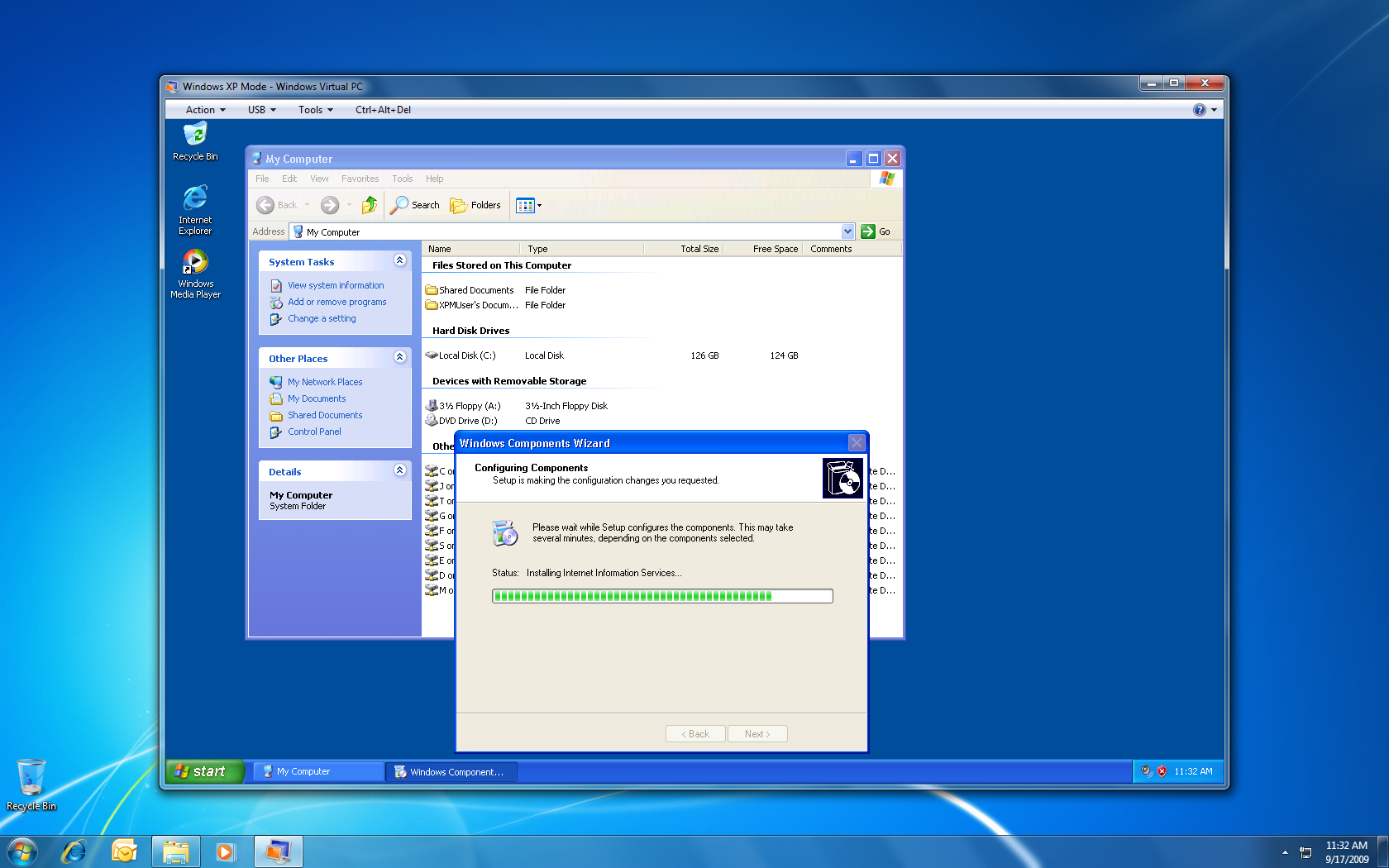
Luckily, I was able to enable hardware virtualization on my desktop (on which I had also done a clean Windows 7 install). Once you have the XP virtual machine running under Windows 7, you install your “legacy” applications normally (inside the virtual machine). For example, in the screenshot below I was adding IIS:
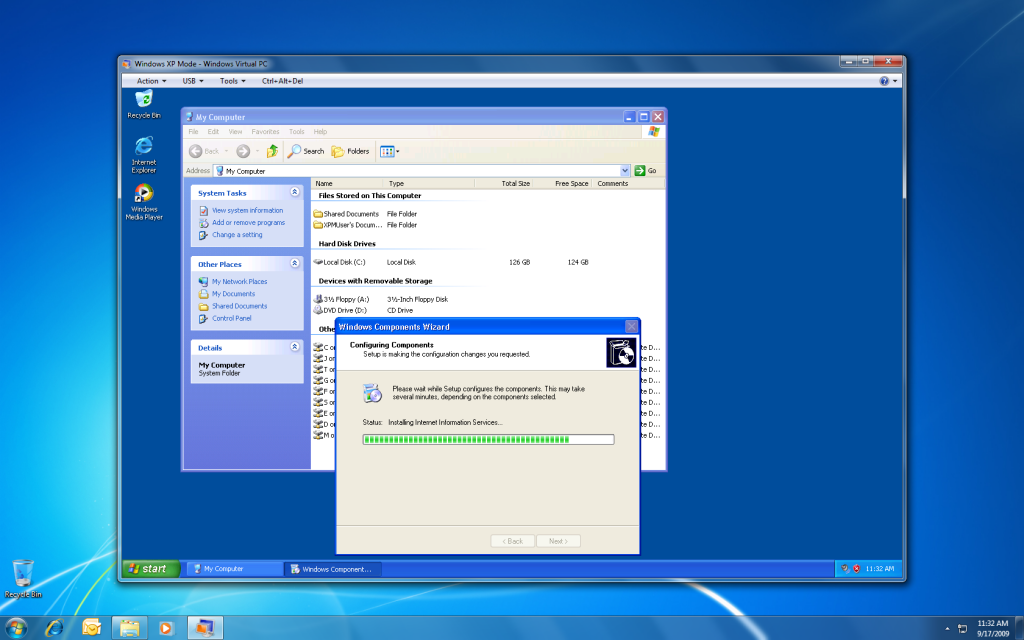
XP Mode in Windows 7

Windows 7 creates corresponding shortcuts for the applications under the XP Mode folder on the Start Menu of your PC (you can also add your own custom shortcuts to that folder by simply creating them under the All Users Start Menu within the virtual machine). When clicking on one of those icons, the application runs seamlessly on the desktop so the user is not even aware the application is being virtualized (except for the old XP Luna-style interface instead of the new Aero glass look). Using XP Mode, for example, I was able to successfully install NetMeeting (which I need to connect to the voicemail system console). It ran just fine “on” Windows 7, with almost no noticeable impact on performance.

It requires a little bit of advance setup but XP Mode seems to be a good way of running any legacy applications that won’t work natively under Windows 7 (assuming the user’s PC supports hardware virtualization, of course).
Trillian Astra is Gold

The developers over at Cerulean Studios announced today that with Build 117, Trillian Astra (for Windows) has gone gold. You can download the free version here.

I’ve been using the beta on Windows 7 for the past four months and am pretty happy with it (I’ve been a paid Pro user since 2004 and have upgraded to the Pro version of Astra as well). I still have one random problem where sometimes if I initiate a conversation with someone on Yahoo, they won’t get my messages, but if they start the conversation we can chat back and forth just fine. The random crashes seemed to have been fixed as well (at least, I don’t think I’ve had one since I got Build 117 a few days ago).

So if you’re looking for a good multi-service IM application for Windows and have been scared away from Digsby, give Astra a shot.

Getting the most out of your TiVo

A TiVo is much more than just a souped up digital VCR. What separates TiVo from your cable company’s generic DVR (other than the awesome features of TiVo service itself) is the wide range of (mostly free) applications you can use to enhance your TiVo experience. I’ve written about some of these applications here before (like Galleon, streambaby, and pyTivo) but I figured one comprehensive write-up might be in order.

Read more

At least this proves Clippy is finally dead

Microsoft is really reaching with some of its latest advertising campaigns. Perhaps you heard about the vomiting woman with IMGIGP (oh  my god, I’m gonna puke) syndrome commercial that they recently pulled? And yes, that was Dean Cain as the spokesman.

Well, check out the latest “ad” for Microsoft Office 2010:

I have to admit that’s pretty creative and humorous, but does it really tell us anything about Office? On the other hand, does it need to?

“Spell check this!” 😀

Microsoft Security Essentials

Microsoft is getting into the anti-malware market.

Microsoft Security Essentials (MSE) is a replacement for Windows Live OneCare and, I think, Defender. Did I mention it’s free? Paul Thurrott has a good write-up on MSE on his SuperSite for Windows.

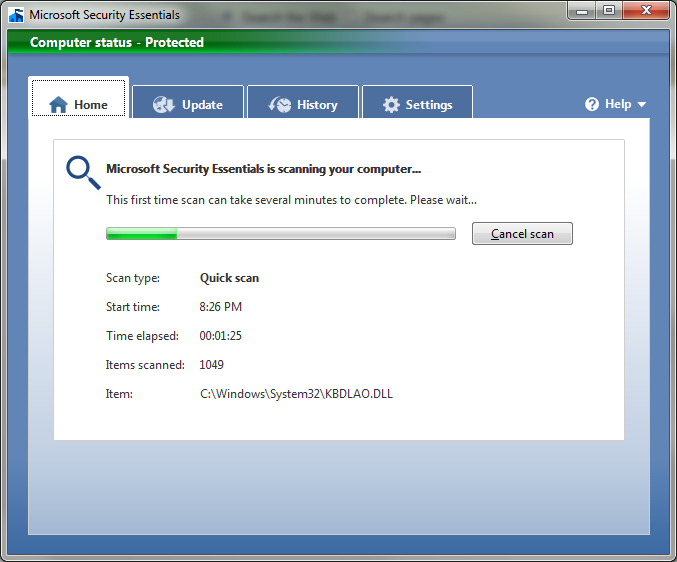
Since I’m already running the Windows 7 release candidate, I figured why not give this a try as well? I downloaded the free beta, uninstalled AVG Free, and installed the new software:

Microsoft Security Essentials

I’ll keep an eye on it for the next few weeks and see  how it goes …