Back in March, in preparation for our recent family roadtrip vacation, I purchased the Polaroid PoGo Instant Mobile Printer. The tiny PoGo prints 2 x 3-inch borderless color images in under a minute onto ZINK (zero ink) paper.
hardware
Acer Aspire Revo 3610
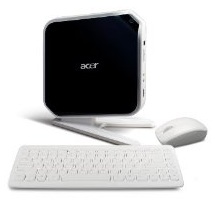 My Dell OptiPlex Linux server was getting louder and hotter in its old age. For the past three years it has been running 24×7 as my media server in the closet. The fan in the power supply had started to whine (especially when the CPU was maxed), and I already lost one hard drive to a crash earlier in the year. I decided it was time to replace it and started looking for smaller, quieter, more power-efficient alternatives.
I call this box a server because it hosts this blog, a small Gallery site, some home media applications for my TiVos, and is running all the time, but I don’t need a server-class machine. My past Linux machines have traditionally been older desktops, even a laptop! So the latest crop of nettops seemed like an ideal solution.
After researching products like the Asus EeeBox, the MSI WindBox, and even the Dell Studio Hybrid I decided on the Acer Aspire Revo 3610. This little box packs in Intel’s dual-core Atom N330 CPU (1.60GHz), 2gb of RAM, nVidia’s ION graphics chipset, and a 160gb hard drive. Peripherals and storage can be connected via the 6 USB ports (one of which is used for the included wireless keyboard a mouse), the eSATA connector, and the SD card reader, and network connectivity includes a gigabit network connection and B/G/N wireless. The Revo has no optical drive, but experience with my EeePCs has made me comfortable with booting/installing from other removable media like USB thumb drives, so no biggie there. Also, since I’m not using the Revo as an HTPC I won’t be using the HDMI or digital audio (SPDIF) connections, but they’re there. The Revo comes with Windows 7 Home Premium pre-installed (although I wish Acer sold a cheaper version without it). If you’re going to use it as an HTPC it comes with a mounting plate so you can attach it right to the back of your HDTV.
My plan was always to put the latest version of Ubuntu on the box. Warranties be damned! After unpacking my new Revo, before even turning it on, I immediately cracked it open, thinking I would make an image backup of Windows 7 just in case (since it comes without a rescue disc). Unfortunately, even with my lack of fear for warranty-voiding, removing the hard drive involved more steps than I was willing to take. So rather than wiping the drive and starting clean, I booted Windows 7, did some initial setup, and then shrunk the primary partition so I could dual-boot Windows 7 and Ubuntu. Considering the current server only had a 30gb hard drive in it (and most of my media is on external NASes), having a 60gb partition for Ubuntu was acceptable to me.
Installing Lucid Lynx didn’t go as smoothly as I anticipated, however. The 64-bit version (imaged onto a 2gb USB stick) wouldn’t even boot correctly and the 32-bit version would start and then complain it couldn’t find the CD-ROM. After figuring out how to manually boot the installer from the command-line, I found this blog post that helped me get through the rest of my installation issues. Shortly, I had my Revo set up as a 64-bit Linux server!
It took me a few days to get everything transferred from the old server to the Revo and then get everything set up and configured the way I wanted. So far I am very impressed with the Revo. It’s very quiet, even when both cores are busy (i.e., folding a work unit and transcoding a video file), and my UPS utilization dropped from 29% to 10%! That’s a serious cut in power consumption. I have noticed a slight performance decrease over the old Pentium 4 Dell, but nothing major and it was expected. It’s well worth the trade-off for the reduced noise and power usage, though!
Out with the old, in with the new!
More Wii homebrew: running games from a USB hard drive
I dabbled in Wii homebrew last year but didn’t do much beyond getting the Homebrew Channel working and messing around with a few apps. Then last week I saw this post on Lifehacker and thought, I have got to try this. The Lifehacker tutorial is pretty straightforward … the Wii hacking community has done some amazing work to make the soft modding process easy and (almost) risk-free. At least I haven’t bricked my own Wii, which is running the latest 4.2 firmware, yet.
I already had the HBC installed and working, but the first problem I encountered was during the DOP-Mii step. For some reason my Wii wasn’t able to download  the IOS updates/patches from NUS (Nintendo’s Update Servers), the same issue as described here (even though wireless connection was working). I wasn’t able to figure out how to get the required WADs onto my SD card for a local install, and trying to re-run the DOP-Mii step was now causing scary crash messages, so I gave up. I noticed that after attempting this, when my daughter went to play Wii Sports Resort, the Wii re-downloaded a system update, so luckily that seemed to reverse whatever the failed DOP-Mii patcher had done to the IOS.
A few days later I found another guide at WiiHacks.com and decided to give this another shot. This time I had the required WAD patches downloaded locally on my SD card so the DOP-Mii step worked as expected. But then I ran into a problem trying to install the cIOS. After some more Google searching I figured out I had to use the AnyTitle Deleter to clear out IOS249 before the new custom IOS would load properly (it’s possible that this was something left over from my last experiment with homebrew). After getting past all of that, though, I was able to complete the rest of the Lifehacker guide as documented.
For my initial testing, I used an old 40gb laptop hard drive I had laying around connected to a barebones USB adapter (pictured to the left) but I’ve since switched to a 320gb WD Elements drive split into two 160gb partitions (one WBFS, one exFAT).
Using the amazing USB Loader GX app, I backed up all of my games to the hard drive and then had it download the various box and CD cover art. It looks fantastic:
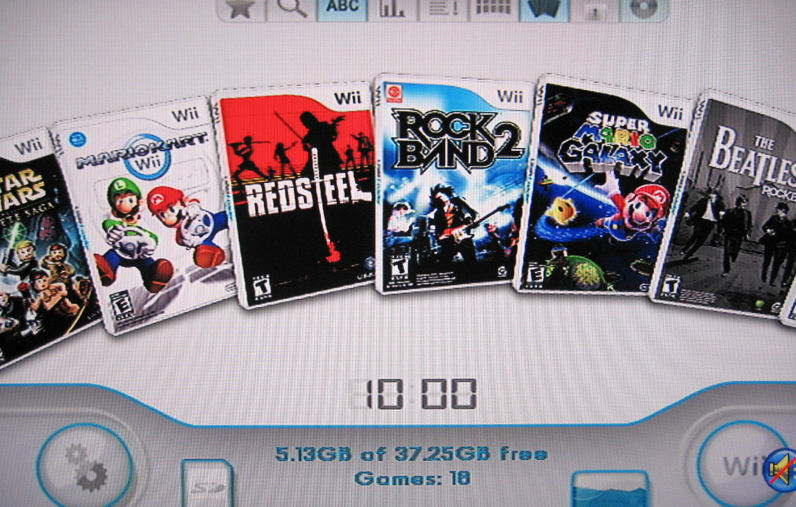
I tested running a few games from the hard drive and they worked just fine (even the online ones like Mario Kart). Sweet! Check out this little video I made to see it in action.
A helpful note: I kept having problems where the USB Loader would crash. It turned out that while moving the SD card back and forth between my PC and Wii, at some point the lock switch moved down slightly so the card was effectively read-only. Fixing the switch resolved the crashes. Just something to keep an eye out for!
CyberPower CP1000AVRLCD UPS
My wife called me at work the other day to report she couldn’t get on the wireless network at home and that there was a loud whining coming from the computer closet. It turned out the UPS (an APC BX800 I bought in 2004) had bit the dust and all of the equipment (server, router, cable modem, NASes, etc.) was off. I had replaced the original batteries (with spares from Batteries Plus) in this UPS back in December 2008, but apparently after 16 months they were dead!
Rather than replace the batteries again, I decided to just replace the whole unit. Normally I would buy another APC using their Trade-UPS program, but after some quick research I determined I could get a better, more powerful UPS cheaper and faster via Amazon. I chose the CyberPower CP1000AVRLCD, a 9-outlet, 1000VA/600W UPS with a nice LCD display (which turns off automatically after a few minutes and allows you to cycle through various information such as load, input/output voltages, battery run-time remaining, etc). Not only does the CyberPower have more VAs (1000 vs. 800) and outlets (9 vs. 7) than the APC, it’s actually smaller and has more features:


I had no problem swapping the units and getting everything back up and running. I connected the UPS via USB cable to my Linux server and NUT recognized it without any problem. Now when I had replaced the batteries in the APC in 2008, NUT thought the UPS was in a constant low battery (LB) condition (maybe due to the third-party batteries?). So when the power would go out NUT would immediately think the UPS was drained and shut everything down. As a result, I had disabled all of the automatic shutdown features and low battery warnings back then. With the CyberPower now in the loop, however, I was able to re-enable all of those features so that’s a nice benefit too.
I did a quick power test (by unplugging the UPS from the wall) to make sure I received the notification e-mails when the UPS switched to battery power and then back to line power. Then to test the shutdown configuration, I pulled the plug again and let the UPS run on battery until the low battery condition was reached.
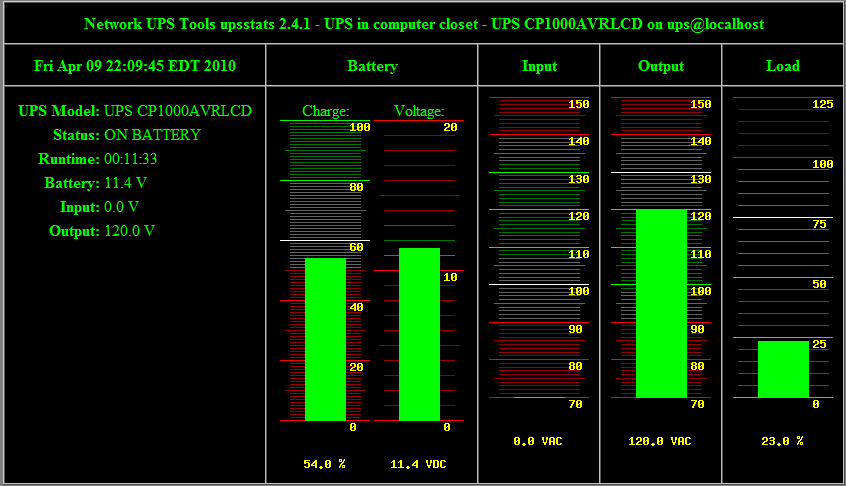
Everything stayed up for about 23 minutes, at which point the LB event was triggered and NUT gracefully shut down the server and then powered off the UPS. A successful test!
As for the old APC? I dropped it off at Staples for proper recycling (which cost me $10 plus sales tax, what?).
Two months with the iPhone
Steve Job’s recent announcement of the new iPad (really?) coincided closely with the two month anniversary of my getting an iPhone. So how have the past 8 weeks or so been?

I’m definitely better at typing on the virtual keyboard. I’m nowhere near as fast (or accurate) as I was on the Treo’s physical keyboard, but I can see a definite improvement over three months ago. Hopefully I’ll continue to get better as I learn more tricks. I’ve also adjusted to life without the clickwheel for basic iPod functions, which still accounts for the majority of my iPhone usage. The audio scrubber is frustratingly inaccurate, however, and I find it diffiicult to use. The voice commands come in handy while driving in the car so I’m finding myself using those more often. At home, we’ve got the Griffin PowerDock dual-charging station so we can keep my and my wife’s iPhones charged without having to pull out the little white charger blocks.
I originally complained about it not being easy to sync the iPhone with multiple PCs, mainly because that made it harder to download content while travelling with my laptop (my primary iTunes machine is my desktop at home). I found that you can download new podcasts directly from the device, which is cool … unless you happen to be using AT&T’s 3G data service instead of WiFi (see the screenshot to the left). No downloading new podcasts while driving in the car. 🙁 To make it easier to sync files (or photos), I’m using DropBox on my PCs and the iPhone. I just move the photos from my camera roll into the DropBox folder using the app and it’s automatically synchronized to all of my other devices running the DropBox client.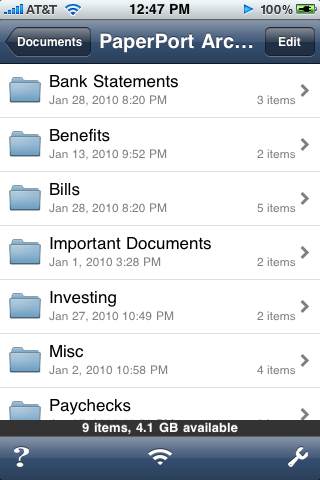
I used to carry a 2gb USB thumb drive around that contained my portable apps and personal documents, but why continue to do that when I’ve got extra room on my 32gb iPhone? I purchased Avatron’s Air Sharing application (screenshot to the right) which for $3 turns your iPhone into a wireless storage device. I can map my iPhone as a drive on my Windows PC (or connect via the browser) and then use my regular synchronization software to copy files back and forth. Yes, DropBox can do the same basic thing, for free, but I’m not comfortable storing some of my personal documents on DropBox’s servers so Air Sharing lets me eliminate that middleman (besides, I’ve got this stuff backed up to my encrypted Amazon S3 account through Jungledisk, no need to duplicate them out in the cloud again). Air Sharing also supports viewing most document types like Word and Excel, PDF, etc.
If you live in a multi-iPhone household and need to keep a synchronized shopping list, you must purchase GroceryIQ. For just $1 you get a full-featured list app that supports multiple stores, aisle and category customization, barcode scanning, and list sharing. If I purchase something on the list and mark it off, it will disappear from the app on my wife’s iPhone so we don’t end up both buying the item. By customizing the aisle order for each store, our grocery shopping is more efficient: no more back-and-forth in the store because we forgot an item that was two aisles back. Everything is listed in the order you go through the store. I was a little disappointed that the recent version includes little ads in your shopping list, but they’re not that intrusive and heck, it was only $1 and that’s well worth the features you get.
i.tv is neat little app (free) that turns your iPhone into a connected TV guide. You can search TV listings for your lineup, see what’s currently on and what other people are watching. What I like, though, are the TiVo features (of course!). After linking your tivo.com account you can schedule upcoming recordings directly from your iPhone. There’s also a feature that turns your iPhone into a WiFi-enabled remove control for your TiVo (Series3 models only). Yes, I can change the channel on my TiVo in the family room from across the house (except you can’t control TV functions like volume, so I still need the remote extender for that). Fun to play with.
Other than those additions (plus a few free games), I seem to be past the initial “must-download-and-try-everything!” stage of installing apps. My list seems to have stabilized around 5 pages of icons, which I try to have organized by type: most-used, utilities, games, work-related, misc., etc. Unfortunately the lack of real customization features on the springboard makes it hard to really categorize the icons so I’m trying to learn to live with that. 🙂 It’ll also be interesting to see which (if any) new features introduced in iPhone OS 3.2 (running on the iPad) make it into the iPhone itself in the next few months.
Apple iPhone 3GS
After over 13 years of using (mostly) PalmOS and (some) Windows Mobile devices as my PDA and/or cell phone, I now own my first device that runs … OS X. Yep, I got an iPhone.
We’re in the early stages of testing the iPhone with our corporate e-mail infrastructure: Microsoft Exchange and GoodLink. Since my AT&T account has been upgrade-eligible for some time (the last time I “officially” upgraded was when my Treo 650 was the hot new device), my boss told me to go ahead and get an iPhone (16gb model, but I paid a little out-of-pocket to get the 32gb one since my current iPod is 30gb). I need to start learning how to use it so I can eventually support it as we roll the device out to other users in the office. It’s been two weeks now since I abandoned my trusty Treo 680 and I had some free time while on vacation last week to really spend some time with the iPhone. Here’re some of my thoughts …
What I Like
- the design and form factor: the iPhone is truly a beautiful thing to look at given it’s mostly screen and a single home button. Even with my Otterbox impact case on, it still fits comfortably in my pants pocket. I miss having a physical keyboard (see “What I Don’t Like” below) but the buttons that are present make sense.
- it’s a widescreen iPod: when music is playing and a call comes in, the music fades away and then the phone rings. When you’re done with the call, the music fades back in, picking up where you left off. One minor nit here, though, is that if you have the e-mail notification sound enabled, your music will fade briefly to play the mail sound, which isn’t necessary (the notification should just be suppressed). I replaced my old Belkin Tunebase FM with the new version for the iPhone so I can charge the device in my car and still listen to podcasts while driving. It includes a speakerphone for handsfree and a single button that works like the home button on the phone: click once to pause/play, twice to go forward a track, twice and hold for fast forward, three times to back a track, thrice and hold for rewind. I like being able to turn the phone sideways and watch video podcasts in widescreen too (although scrolling through podcasts is uncharacteristically choppy).
- the GPS: using the built-in GPS and compass for location-based/direction-based services is really slick. Pulling up Google Maps and watching the blue dot move along a highway as I drive is like a scene out of a spy movie. Check out Yelp’s monocle feature for a perfect example of augmented reality using these features.
- the camera: I’ve been stuck with the VGA (640×480) camera in my PalmOS devices for so long! It’s great to finally have a mega-pixel camera (with video even!) that takes pretty good pictures. I love the geo-tagging feature too.
- the speaker: being able to play music without headphones or external speakers is a definite plus.
- oh yeah, it’s a phone: when held up to your ear, the screen turns itself off. Take it away from your ear, and the screen fades back into view. You don’t have to navigate through a voice response system to record your voicemail message or retrieve your messages, just tap the buttons on-screen. It’s those little things that continue to impress me. Of course, I haven’t actually used it a lot as a phone since it does so much other cool stuff.
What I Don’t Like
- the keyboard: no one can argue that the iPhone’s virtual keyboard is better than then Treo’s. Typing on glass just isn’t the same. I’m getting better at two-thumbing it, but I still find typing (quickly) a frustrating exercise.
- iTunes: I haven’t looked into this much yet, but having to use iTunes to sync and customize the phone is a pain, especially if you’re using more than one computer. For example I sync my iPhone with my main desktop machine at home. While travelling over Thanksgiving, I had my laptop with me, but could not use iTunes on it to manage my phone. This is really going to be a pain at work when I’m trying to configure multiple iPhones for people in the office. I found the iPhone Configuration Utility but still need to read up on enterprise deployments.
- syncing (or lack thereof): requiring iTunes also makes it difficult for applications to sync their data for backup. Palm had HotSync and conduits which allowed third-party developers to create custom “tunnels” in HotSync that were basically transparent to the user. To sync my eWallet desktop with my iPhone data, I have to open each application (on my PC and the phone), and then start the sync over WiFi (totally outside of iTunes). A kludgy workaround due to Apple’s control freak design. Even the photos and videos you take on the iPhone don’t sync down to your PC through iTunes, instead you have to use the built-in features of your PC since the device appears as a plain storage device (although you can sync certain folders of photos back to the iPhone from your PC if you want to carry a certain collection around).
- I miss the clickwheel: using my iPod in the car without looking was pretty easy with the clickwheel. I was even pretty good at skipping most commercials (half a turn on the wheel was about 30 seconds). The iPhone isn’t as easy since it doesn’t have a lot of buttons. Yes, you can use the home button to skip tracks, or FF/RW, but for more accurate positioning you have to use the on-screen scrubber with your finger, which is pretty dangerous to do while driving.
- lack of customization options: sure I can drag the app icons around to different pages, but I can’t rename them, can’t leave empty spaces on the grid, can only assign a few different options to the home button, etc. Sure, I could mess around with jailbreaking and probably address some of those concerns, but I need to be able to support this device at work so I can’t deviate too much from the delivered experience.
- battery life: forgive me … I’ve been using a Treo on the Edge network for almost 4 years and battery life was pretty darn good. I’d only have to charge it overnight and it was good for all day. 3G and all the other cool stuff I can do on my iPhone really sucks the battery dry quickly. When I had my separate iPod and Treo, it didn’t matter if my iPod died while listening to music during the day since my phone still worked. Now that I have this single device I need to be more careful about making sure I keep it charged. The lack of a user-replaceable battery is a downer too. It’d be nice if I could just buy a new battery and put it in myself instead of having to send the whole phone back to Apple for a “repair.”
- fingerprints: it really sucks that 5 seconds after taking this beautiful shiny piece of technology out of the box it’s covered in my greasy fingerprints. The matte finish screen protectors I got at the AT&T store do a decent job of hiding them, though, and make the screen a lot less reflective and not so glassy to the touch.
- it’s delicate: this will take some time to play out, but the Treos were solid. Not that I drop my phone a lot, but when I do, it’s usually in a bad way. The Treo might have gotten scratched or scuffed, but it kept on working. Little plastic tanks. I’m not so sure about the iPhone. I already dropped it once onto concrete but luckily I have that impact rubber case and it landed screen up. The folks in the office are pretty hard on their devices (based on the drawer full of broken phones in my desk) so it’ll be interesting to see if the iPhone is up to their abuse.
What Apps Do I Use?
There’s an app for everything, right? Another of the big draws of the iPhone is the thousands of applications available in the iTunes App Store. One of the first things I had to do was find iPhone equivalents of the applications I used on a daily basis on my Treo. Here’s what I’ve got so far.
- What I used on the Treo: eWallet
- What I switched to for the iPhone: eWallet ($10 for iPhone, or $20 usable on multiple devices including PC)
Like anyone, I have a lot of passwords, logins, and various personal private information I need to carry around with me. To keep all of this sensitive information secure and portable, I’ve used Ilium Software’s eWallet application for many years. Luckily this switch was easily since Ilium has PalmOS, Windows Mobile, PC, and iPhone versions of eWallet, and now I’ve used them all. Migrating my data was simple, although synchronization between the desktop and iPhone versions is a little cumbersome since you have to initialize the sync on both devices at the same time over WiFi. Still, being able to access all of my passwords, accounts, and other stuff I store in my wallet on the iPhone is great.
I also keep a lot of random information on my handheld: gift ideas, vacation days, clothes sizes, various house information/measurements, lists of all sorts! So Ilium Software’s ListPro was another application I relied heavily on, using it both on my Treo and desktop PC. Unfortunately, Ilium hasn’t produced an iPhone version of ListPro yet so I had to search for alternatives. I ended up trying Evernote, which has iPhone and PC versions (in addition to many more, including via a web browser). Evernote requires you to create an account on their website, so technically your notes are being stored on their servers and then synced with your different devices. You can store text, images, documents, etc. but keep in mind the only notes you can actually edit on the iPhone have to be plain, unformatted text (so no checkboxes, bullets, etc.). Creating notes on the iPhone has the benefit of automatic location tagging, using the phone’s GPS. The basic free service has a limit on how much you can upload a month, so there’s a premium service you can pay for without those limits and also includes things like extra security. I had to manually copy/paste all of my lists out of ListPro into Evernote, which was a bit of a pain, but it did give me the opportunity to clean up and re-organize some of my lists.
- What I used on the Treo: Tasks (GoodLink)
- What I switched to for the iPhone: iMTasks (no longer available, replaced by iMExchange 2)
With GoodLink on my Treo, my e-mail, contacts, calendar, tasks, and notes from Outlook were all synchronized in near real-time. The iPhone handles the e-mail, contacts, and calendar, but not the to do list or notes. I am a heavy user of Outlook tasks so I really wanted those synced to my iPhone. For whatever reason, Apple decided not to bake that in. Instead, I had to purchase RERLSoft’s IMTasks app. Once I entered my Exchange information, the app downloaded my to do list and keeps it synchronized (although only while the app is open). Hopefully the forthcoming GoodLink client for the iPhone will include this (update, 07/2012: almost three years later and it’s still not part of the Good app), but for now this was a must-purchase function for me. RERLSoft has a version that includes Outlook notes synchronization (and also allows you to manage your out-of-office setting), but since I’m using Evernote now I decided to stop using Outlook notes altogether.
- What I used on the Treo: TealAuto
- What I switched to for the iPhone: Gas Cubby ($5, free lite version available)
Some other data I keep on my phone is car information: gas mileage, repair history, etc. On my Treo I used TealPoint’s TealAuto application to store and track fill-ups, repairs, maintenance, etc. Without an iPhone version, I tried out a few of the vehicle apps in the App Store, including the free “lite” version of Gas Cubby and eventually ended up purchasing the full version. Using the Windows version of TealAuto, I was able to export all of my data from my Treo into a CSV file. Then, using App Cubby’s unsupported import feature, I was able to load it all into Gas Cubby. The import only supports gas events, though, not maintenance, so I manually entered our 2009 maintenance events into the app later (not a big deal since there were a lot less of those compared to fill-ups). If you’re a multiple iPhone home and purchase multiple copies of Gas Cubby, you can even keep the data synchronized across devices, which is a cool feature.
- What I used on the Treo: iSilo
- What I switched to for the iPhone: Stanza (free)
If you read this blog you know I do a lot of reading on my PDA. There’s not a version of iSilo for the iPhone so I had to try out a few free e-readers. I settled on Stanza. Using the desktop version, I was able to convert the book I’m reading from the Baen free library from HTML into a format for the Stanza reader and transfer it to my iPhone. Having the larger, higher resolution screen on the device is great for reading. Plus you can change font sizes, colors, and themes (black on white, white on black, textured, etc.). I’ve also installed Amazon’s Kindle Reader (free), in case I decide to purchase some new e-books. No need for a Kindle now! Interesting, though, that Stanza is actually owned by Amazon. I wonder if eventually they’ll combine these apps?
Why do I like remoting into my Linux server from my phone? Because I can, of course! iSSH let’s me login to my Ubuntu box at home via command-line or tunnelled VNC. The free iRdesktop utility lets me connect to my Windows servers at work when I have my iPhone connected to the VPN. Amazing. There’s even a free Citrix client (but I haven’t gotten it to work properly yet).
My daughter loves playing iRogue on my Treo and I like it too, so of course I needed the iPhone version! 😀
Some other apps I’ve purchased/installed include:
- iEmergency+ ($1) allows you to store your emergency contact information (phone numbers, medical info, etc.) in a single place and also has a helpful utility for adding ICE information to your iPhone’s lock screen.
- Using VIP Access (free) means I don’t need to carry around my PayPal football or VeriSign Secure Card since my iPhone can now act as my security token.
- The iPhone doesn’t allow for multiple e-mail signatures when you use multiple e-mail accounts. JohnHancock ($2) lets you create and switch between as many as you need. There doesn’t seem to be an elegant solution, but this app at least provides one.
- RedLaser ($2) is an amazing barcode scanning application. Point your iPhone’s camera at any barcode and the app will pull up a list of prices from other stores. The latest update even uses the GPS to find local prices. If nothing else, it’s fun to play with.
- Chess with Friends (free) and Words with Friends (free) from New Toy, Inc. are basically chess and Scrabble games you can play “online” with other iPhone users. Really cool for playing with friends or relatives who live far away. We used both of these games in the car on our recent Thanksgiving holiday trip to play games without having to pass a single iPhone back and forth. 😉
What Do I Think?
The iPhone is a really slick device. The first few days were rough for me, since I was really set in my ways with my Treo and doing things in a certain way. Over the past two weeks, though, as I’ve had time to get better acquainted with my new shiny toy business tool, I have to admit it is a well engineered piece of hardware and software. Now I have a single device that really covers all the bases. Pretty incredible.
Got any other must-have/must-try apps for me, or other iPhone advice, tips, or tricks? Leave me a comment!
Garmin nüvi 265WT
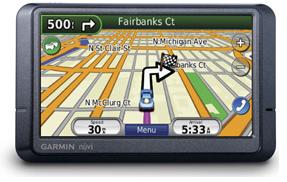 A couple of weeks ago, I discovered that my trusty Garmin StreetPilot c340 wouldn’t run on battery power anymore. As soon as it was disconnected from the power cable in the car (or from the USB cable when connected to my PC) it would just turn off. When plugged in, the screen would show it was “charging,” but after trying multiple hard resets and even opening a ticket with Garmin it became apparent the internal Li-on battery was dead. The Garmin rep told me it would cost a flat $89 to fix it! I did a little research and determined that it would be cheaper to attempt to replace the battery myself, as long as I didn’t mind purchasing a replacement battery, cracking open the case, and doing a little soldering. Other than the lack of battery power and some minor map problems the unit was working perfectly fine so I wavered back and forth (repair or replace?) for a bit. Eventually I decided to just sell the StreetPilot on eBay and put the proceeds towards a newer unit.
My new GPS is the Garmin nüvi 265WT which has a 4.3″ widescreen touch display, voice directions (with text-to-speech), Bluetooth, a built-in FM Traffic receiver, and a few other cool features.
Navigation and General Usage
The thing I liked the best about my StreetPilot was the user interface. It was simple, clean, and good looking. The nüvi sports that same simplicity and shiny UI that makes it easy and fun to use:

The large buttons make it easy to navigate using your finger and the touchscreen, and the widescreen format allows the nüvi to show more information on the screen without it getting in the way of actually seeing the map as your driving. One new feature I like is the indicator of the current road’s speed limit (although as you can see above I was going slightly over that on my way home from work this evening ;-)). Another benefit of the widescreen model is a QWERTY keyboard layout instead of the alphabetical one used on the StreetPilot, which makes text entry a lot faster.
The standard text-to-speech voices are present so the unit will read out street names when giving directions. You can also download other voices (and car icons) from the Garmin Garage. There’s not as wide a variety of voices available as there are for my sister’s TomTom unit though (even NavTones only has a total of 3 voices compatible with Garmin units).
In addition to the normal method of entering destinations (by address, by name, by coordinates, etc.) you can upload geotagged photos to the nüvi and have it calculate the directions to that location. I don’t see myself using this feature very often unless I’m just looking for some random place to go. I may, however, introduce my daughter to geocaching, as using the Garmin Communicator plugin for my browser in conjunction with the Geocaching.com website makes it really easy to send cache locations to the GPS (and there are apparently quite a few caches near my house).
Bluetooth
The built-in Bluetooth radio lets you use your mobile phone with the nüvi for hands-free calling. I had no issues pairing my Treo with the GPS and then using the touchscreen to place a call.

You can answer incoming calls too, of course, and even “transfer” the call to your phone if you don’t want to use the speakerphone. Voice quality was pretty good on both ends. The nüvi even downloads your call log and address book from your phone allowing you to browse and dial from the device instead of looking at your phone (although the address book part didn’t work for me since I don’t use the Treo’s native contacts application). If your phone supports voice dialing, you can do that through the nüvi as well. Another neat feature of pairing your phone is that every phone number on the display turns into a hyperlink you can use to place a call. So if you’re stuck in traffic on your way to your dinner reservation, you can simply tap your destination’s phone number on the screen to call and inform them you’re going to be slightly late.
Traffic
Of course, you should have been able to avoid that traffic in the first place! 🙂 My StreetPilot supported traffic information, but you had to purchase a separate receiver and pay for a subscription. The nüvi comes with an integrated FM Traffic Message Channel receiver and a free lifetime subscription to the service (but there’s a catch, see the next section below!). My minor nitpick here is that the receiver is not “integrated” into the GPS unit itself but is part of the power cord. Thus, you can’t get traffic information unless your unit is plugged in with the car lighter adapter. I guess this makes some sense (you don’t need traffic information if you’re hiking or riding a bike), but I was disappointed that I have to have that bulky cable plugged in as I usually just have the GPS mounted to the windshield without the cord.
That aside, the service is a neat add-on. The traffic indicator on the map screen (see the upper left-hand corner of my first screenshot) will change color (green, yellow, red) to indicate the level of traffic ahead. If the nüvi detects heavy traffic along your way, it may automatically adjust your route around it. You can also get an overview of all of the traffic in your area:

And then see where it is in relation to your current location:

Advertising!
The nüvi 265WT comes with a free lifetime subscription to the FM traffic service, but “free” in this case means “ad-supported.” That’s right, spam on your GPS! 🙁

Tapping on the “offer” will show you a list of nearby locations associated with the coupon. Tap on the location and you’ll be routed there. It wouldn’t be so bad if these only appeared on the traffic screen shown above, but these little pop-ups will also appear on the main map screen while your navigating! Ugh! The only way to disable them is to disable the traffic receiver, so if you want traffic information you’re going to have to deal with the ads. So far I’ve only seen these two Best Western ones, so it’s possible I might change how I feel about this depending on what kind of ads I see. It’s not like these are targeted to my preferences, though, so I’m guessing they’re going to be more annoying than useful.
Other Misc. Features
ecoRoute is Garmin’s new addition to their software aimed at increasing awareness of how driving habits affect things like your gas mileage. You can set up your vehicle profile (city/highway estimated mileage, gas type, and local cost-per-gallon) and then get detailed usage reports, like this:

This trip information is also stored in a CSV file you can download from the device and then load into your favorite spreadsheet to do some more analysis if you want. ecoRoute also adds a “Less Fuel” option to the traditional “Fastest Time” or “Shortest Distance” routing options. There’s even an ecoChallenge game that tracks your driving during a trip (how fast you accelerate, brake, keep a constant speed, etc.) and then rates and scores you at the end with the hope that you’ll try to beat your top score by changing the way you drive. That part reminds me of my wife’s Toyota Camry hybrid which has similar driver feedback mechanism to encourage eco-friendly driving habits.
I also like the nüvi’s built in screenshot feature (which I used to capture all of the images in this post), and the ability to easily change the boot screen. No more using xImage!
Finally, when connected to your PC via USB, the nüvi shows up as a 1.8gb flash drive making it extremely easy to transfer files to and from the device. 1.2gb of that is taken up by the system software and maps, but that leaves roughly 518mb on-board for custom vehicle icons, voices, POI files, photos, etc. The nüvi has an SD slot as well, but with all of that free space I probably won’t need to use it as much as I did with my StreetPilot.
We’re going on a quick weekend trip up to Atlanta this weekend (to see Good Eats Live!) so I’m sure I’ll have some more comments after I put the nüvi through its paces on a real road trip. So far, though, I’m really impressed with it.
Cookin’ up some Wii homebrew
I saw this post on Lifehacker yesterday about installing homebrew on the Wii without needing to use the Twilight Princess hack and decided, what the heck, let’s give it a try!
Wow, talk about amazingly simple. Only minutes after downloading the necessary files, I had the Homebrew Channel running on my Wii.
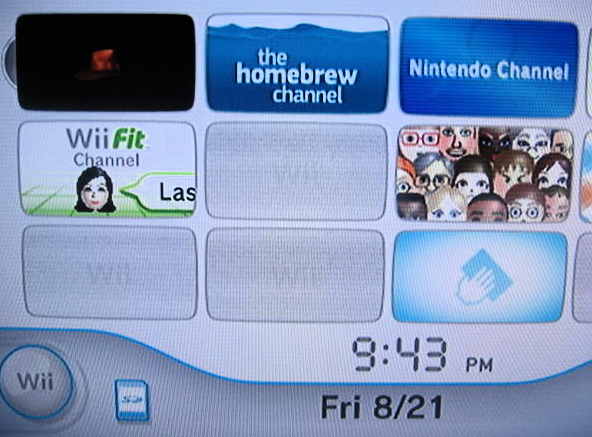
After doing a little more browsing and downloading, I had a few homebrew apps to play with.
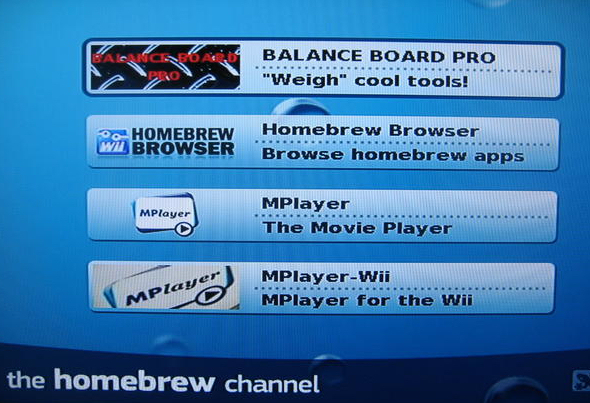
Pretty slick. Using MPlayer I was able to play both a commercial and self-created DVD using the Wii remote for the basic controls. I’ll be honest, DVD playback on the Wii isn’t going to replace a standalone DVD player yet, but for a homebrew app, it’s pretty cool. Nintendo really should just build that functionality in! With MPlayer-Wii I was able to stream an .AVI video off of my NAS (via samba) for playback through the Wii. I hard to hardcode the filename in the configuration file, so this isn’t a complete video library solution (like what I do with my TiVos) but the possibility is there.
I played around with a few homebrew games like Duck Hunt, and plan to check out Quake and Doom. For now, as you can see from the screenshot above I’ve kept the Homebrew Browser (which allows you to install apps right from the Homebrew Channel instead of having to use your PC to download and then copy them to the SD card) and Balance Board Pro which shows off some of the features of the Wii Balance Board.
Cool stuff!
Vizio VECO320L 32″ LCD HDTV
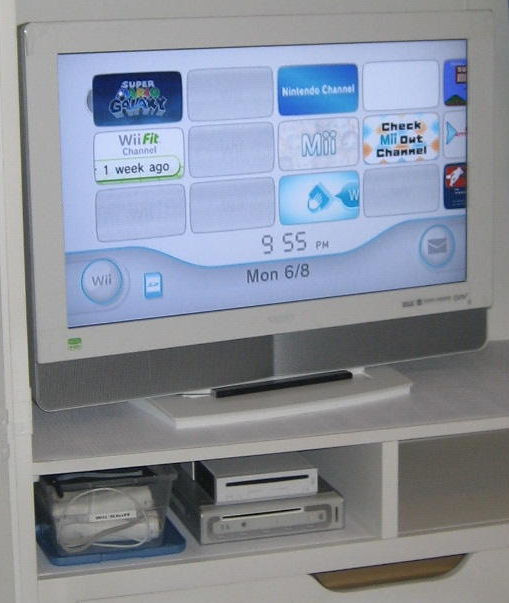 We’ve been transforming our guest bedroom into a combination guest bedroom/exercise/game room. The TV in that room was an old silver 13″ Magnavox tube that just wasn’t going to work for playing Rock Band 2 on the Wii, so I started shopping for a new flat screen television.
While I wasn’t specifically looking for a white display, once I found the Vizio VECO320L 32″ LCD HDTV it made perfect sense: it was a good size for the armoire and matched the white furniture in the room.
I couldn’t find the VECO320L locally in any store, so I ended up ordering it from target.com (with free shipping). It arrived earlier this week so I set it all up and then moved the Wii over from the family room. I don’t have a spare TiVo (yet?) to hook up to the new TV, but the built-in ATSC tuner is pulling in all the clear QAM HD channels over my Brighthouse cable service (and they look pretty good).
Vizio touts the VECO320L as an EnergyStar 3.0 compliant “green” display that uses 15% less energy. According to my Kill-a-Watt, the VECO320L uses about 65W while running (the manual states an 85W average). While I have no other 32″ LCD displays to compare that to, my Sony 23″ LCD uses 53 watts while powered on (110W max) and my Panasonic 42″ plasma gobbles a whopping 225W while running (with a listed max of 395W!). No surprise there, though, as plasmas are known to be power hogs. In standby mode the Panasonic uses 18W whereas the new Vizio uses 0.4W when “off” (which makes me wish the Panasonic had a true off mode).
It’s only been a few days, but so far I’m very happy with our new TV.
My new Eee PC 900A and Windows 7
Last week I stumbled on a deal over at Woot!: a refurbished Asus EeePC 900A (1gb RAM, 4gb SSD) for $160. My addiction to shiny things had me clicking on the “Buy” button before I could stop myself. Considering my original 4G Surf cost twice that (albeit over a year ago) it was too good a deal to pass up.
The 900A has a 9″ screen (running at 1024 x 600 resolution) and is overall slightly larger than my 4g Surf (it still fits nicely into the neoprene sleeve case, though). Like my 4G Surf, it also lacks Bluetooth and the webcam.
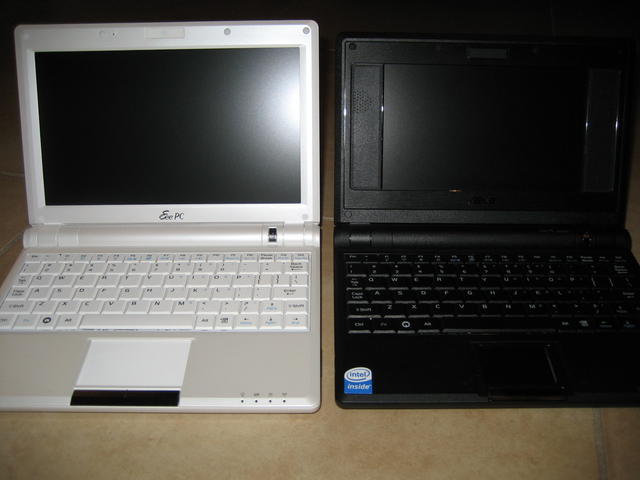
Out of the box it had the Xandros Linux distro installed but I wasn’t about to go back to using that. From the moment I ordered the unit I had plans to put the Windows 7 release candidate on it.
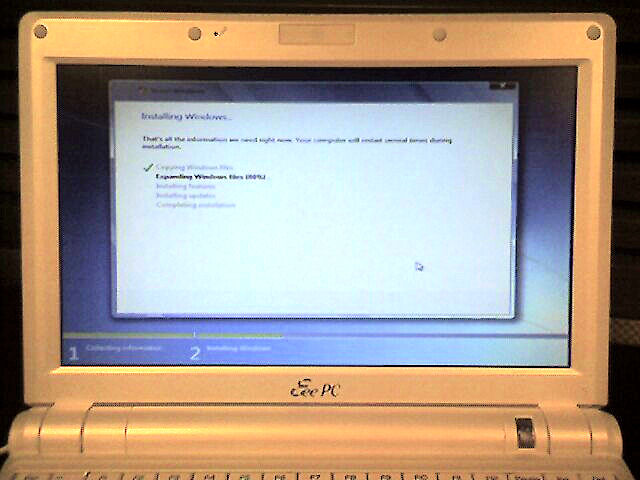
The first thing I did was a quick disk image using eeebackup just in case I should ever want to put the clean Xandros image back on it. Then it was time to research how to install Windows 7. Cramming a full Windows 7 install into 4gb of hard drive space requires some creativity. Luckily there are a lot of creative hackers out there. I ended up using a combination of various blog and forum postings (see the end of this post for the links) to create a bootable, vLite‘d version of the Win7 RC on a thumb drive and then used that to install it on the 900A:
After some post-install configuration, cleanup, and compression, I had a trimmed down (but functional, even with Aero effects!) version of Windows 7 on my new Eee with about 1.4gb free on the SSD.
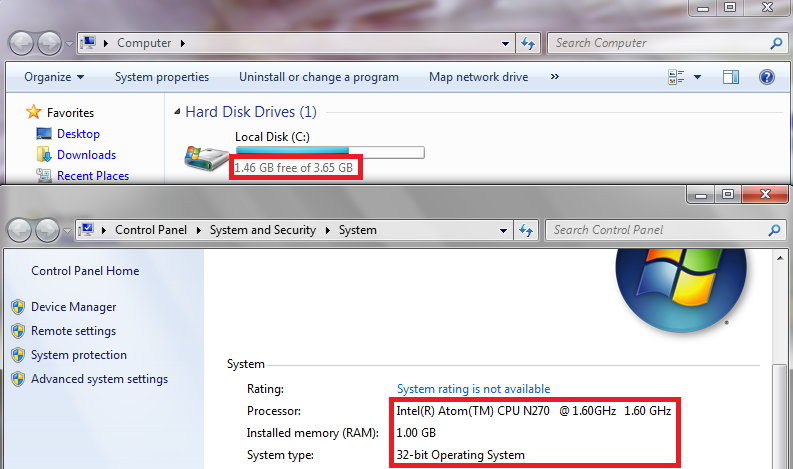
I still need to put some more software on it (like AV software, Firefox, and maybe Office) so that final free space number will most likely be smaller. I’ll probably end up having to use an SD card for cheap, extra storage.
I think I’m taking a performance hit since I compressed the entire drive. Windows 7 isn’t super snappy, but it runs. I’ll give it a shot for a while and see how it goes before I consider switching to Ubuntu like I did on my 4G Surf.
Install Windows 7 on Asus Eee PC 900
Easy direct install from SD card to 4gb SSD
How to vLite Windows 7 Beta 1 and install it on a 901 using an SD card
The noobest noob guide to install Windows 7 directly on your Eee PC