
YEAH LIGHTNING! 2004 Stanley Cup Champions!
World Readable: a personal blog about anything that comes to mind for anybody who cares to read it.
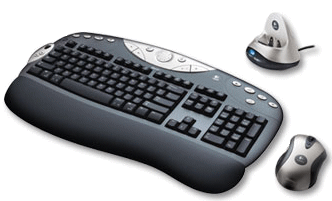 Much as I loved my old Microsoft Internet Keyboard Pro, it had been discontinued by Microsoft, and the media keys didn’t seem to work to well with the latest players. Also, it was white, and everyone knows that black (for computer accessories) is the new beige. So it was time for a change, and why not go wireless? I now have the Logitech Cordless MX Duo, a wireless keyboard/mouse combination, which also replaced my Microsoft Optical Trackball Explorer. The keyboard has (as most do nowadays) several programmable hotkey buttons and dedicated media keys. The mouse features a scroll wheel, forward/back buttons, continuous scroll up/down buttons, and includes a handy charging cradle (which also contains the wireless receiver).
Logitech also has a Bluetooth version of this package, but since I don’t have any other Bluetooth devices (except my iPAQ), I decided to save the extra money and stick with the 27Mhz wireless version.
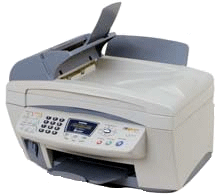 My old Brother MFC-7150 multi-function (color printer, fax, scanner, copier) was starting to get old. I hadn’t used it as a printer in months, maybe even years (it was at least before I got my Epson C80). It was still doing duty as my scanner, but that was about it, and it was time for a change.
Ever since I put in the home network, I’ve wanted to be able to scan over the network, rather than having to have the scanner directly connected to only one PC, so I decided my next multi-function would have to have network support. After surveying the field, I chose the Brother MFC-3820CN. For under $200, you get a flatbed/sheetfed color scanner, copier, printer, and fax machine. It also has media card slots to allow for printing photos right off Compact Flash, Smart Media, etc. The built-in networking capability allows me to print, fax, or scan from any PC on the network, and you can even scan to e-mail! Very cool.
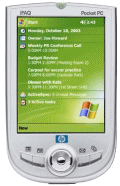 I’m a long-time PDA user. I got my first Pilot 1000 back in 1996, then eventually upgraded to the Palm III. Over the summer of 2001 I left the Palm world for the Pocket PC, or Windows Mobile as it’s referred to now. My first iPAQ was the 3135 (black-and-white version) and then I inherited an older color 3760 model from a colleague.
Currently I have the hp iPAQ h1945, which is smaller and cooler than any PDA I’ve had before. The high-resolution, 64,000 color screen is still the best in the industry, it runs Windows Mobile 2003, and has built-in Bluetooth connectivity. The newer iPAQs forgo the old expansion sleeves (to add on Compact Flash support) for an integrated Smart Media slot (which I’ve never used, actually). This means I don’t really have a need for my IBM MicroDrive anymore, but oh well … it’s not the first time I’ve bought something for the “cool” factor and then never used it. 🙂
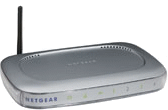 I was getting frustrated with my first-generation Linksys wireless router, the BEFW4S11, that I had originally purchased back in 2001. All I needed was a good price on Amazon, coupled with a manufacturer rebate to convince me to get the Netgear WGR614 wireless router to replace it for just under $50.
The WGR is a wireless G router, which means I get a 54mbs connection from my Sony VAIO to the router, but all of my existing B devices (other PCs, the TiVo, etc.) connect at the lower 11mbs. As with any router now-a-days, it’s easily configurable through a web interface and has very nice management features. It’s also smaller, and only has one antenna, but my site survey of my house seems to suggest that it has the same range as the dual-antenna’ed Linksys device. So far I am much happier with it than I was with the BEFW4S11 and am slowing migrating all of my Linksys hardware to Netgear.
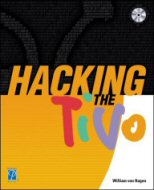 Last Christmas (2002), I received a little black box called a TiVo and it totally changed the way I watch TV (I know, I sound like an ad, but it’s true!). Exactly one year ago today I posted to this blog about it.
Now, one year later, my TiVo is a little bit cooler. For Christmas this year I got William von Hagen’s “Hacking the TiVo” book. After reading it through, I was able to upgrade my 40hr Series2 unit to 140 hours by replacing the stock 40gb hard drive with a new 120gb one. Not bad for about a $100 upgrade and three hours of my time.
As always, the TiVo Community Forum is a great place to go for more information.
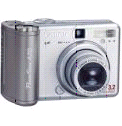
Two-year olds and technology just don’t mix: my daughter recently dropped my Kodak DX3600 and broke it. After hearing from Kodak that I could either send it in along with $125 to repair it, or trade it in for a discount on a newer Kodak digicam, I decided to shop around and get a new camera altogether. Magazine and peer reviews convinced me to get the Canon PowerShot A70. Smaller than my Kodak (but heavier due to 4 AA batteries), this little guy packs a 3.2 megapixed CCD, 3x optical zoom, 5-point auto-focus, and all of the other normal functions you’d expect to find on today’s modern digital camera. It has 12 (!!) different shooting modes, which cover just about everything. When I’m daring enough, I can switch into manual mode to play with f/stops, shutter speeds, white balances, etc. If I don’t want to mess with that, I just leave it on auto. It also records movies (with sound) in AVI format, with a maximum resolution of 640×480.
One thing I do miss about the Kodak is the EasyShare docking system. It was great to drop the camera into the dock, press the button, and have the pictures transferred onto my PC. The Canon, despite its USB connection, doesn’t show up as another storage device in Windows Explorer, and requires some fiddling with the included software to transfer pictures. It does have a TWAIN driver though, which allows me to import the pictures directly into Paint Shop Pro for editing. Another missing piece: built-in memory. The Canon requires a CF card (the Kodak took CF cards, but also had 8mb of internal memory in case my cards got full or I forgot them altogether). Now that I’ve got a 128mb CF card in the camera, though, space shouldn’t be an issue.
Living in Florida means living with power outages, especially during the heat of summer or wild electrical storms. This convinced me to at least try out a UPS. I currently have a single Belkin Home Office UPS 650VA. In my informal testing, it’s kept the wireless router, cable modem, and Linux server running for about 20 minutes. It comes with Windows-compatible software drivers, which I don’t use, but I was able to use NUT (Network UPS Tools) on the Linux server to enable it to monitor the UPS via the serial connection and shut itself down when the battery gets low.
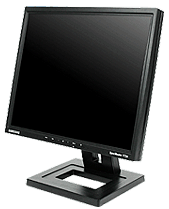 If you’ve read most of this blog, you’ll have noticed that I tend to use my “toys” for a long time (I had the same mouse for 10 years and used my Sony Mavica digital camera for many, many years before upgrading). My monitor was in a similar position: I had purchased my MAG Innovision DX15F (a 15″ CRT) at a computer show in July 1993. So it was no wonder, almost 10 years later (sense a pattern here?) that it was starting to get dimmer and blurrier. Sounds like a good excuse to me to make the jump to an LCD monitor!
I selected the Samsung 172N, a black, thin-bezelled 17″ flat screen LCD. With its native resolution of 1280×1024 I have plenty of screen real estate, fonts are crisp and colors are good. The only annoying thing so far: one dead pixel, stuck on green (according to the Samsung site, however, a certain number of dead pixels are acceptable, so there’s not much I can do about it). Now I have a lot more room on my desk and the screen is farther away from my eyes … good news all around.
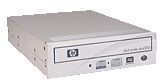 Now that I have a DVD player, what better thing to have than a DVD burner? After doing what I thought was decent research on the DVD writer alphabet soup out there (-R, +R, -RW, +RW, -RAM, etc.) I chose the HP dvd300i (though I did consider Sony’s multi-format DRU500AX). The HP drive is a +R/+RW format rewritable drive, and I had read that these formats are compatible on 85% of the DVD players out there. I guess I should have considered the fact that my DVD player was made by Panasonic, who is one of the originators of the -R/-RW format. Ooops! As a result, the DVD movie collections I create on my PC won’t play in my living room (or my laptop for some reason). They play fine on my PC, of course, since they play on the same drive that created them. Anyway, I love having the large capacity (4.6gb) of DVD discs now for backups and such. Just beware when researching compatibility!