WIJFR: Overclocked: Stories of the Future Present

In these quirky, brashly engaged โ€œstories of the future presentโ€ Cory Doctorow shows us life from the point-of-view of the plugged-in generation and makes it feel like a totally alien world. — Claude Lalumiere, Montreal Gazette

“Overclocked: Stories of the Future Present” is a collection of short stories by Cory Doctorow. It consists of:

  • Printcrime
  • When Sysadmins Ruled the Earth (my personal favorite)
  • Anda’s Game
  • I, Robot
  • I, Row-Boat
  • After the Siege

Since Cory publishes all of his work under the Creative Commons license, you can download all the short stories for free, in various formats. I read all of them on my Treo 680 using iSilo.

If, after reading “Overclocked” you want more, I highly recommend “Down and Out in the Magic Kingdom.” You’ll never look at Disney World the same way again.

WIJFR: Mariel of Redwall

Heaved off her ship in a pirate raid, Mousemaid Mariel is washed up on the shores of Mossflower. With no idea where she is, or indeed who she is, the young warrior mouse embarks on an unforeseen adventure that will take her to the very heart of Redwall and into the arms of the people who live there.

So I’ve finally caught up with my daughter and finished the fourth book of Brian Jacques’ Redwall series, “Mariel of Redwall.”

Just like J.K. Rowling’s first few Harry Potter books, I’m beginning to see the pattern in Jacques’ novels:

  • new enemy/bad guy is introduced
  • all is peaceful at Redwall
  • an event occurs that requires some Redwallers to leave on a perilous quest, directed by the spirit of Martin the Warrior and mysterious Abbey writings/poems/riddles, joined by other friends along the way
  • while the questing party is gone, Redwall comes under attack and must be defended by the peace-loving Abbey dwellers
  • the Abbey is successfully defended, though some lives are lost
  • the questing party returns successfully to the Abbey
  • a final journal entry by an Abbey dweller sums up the final events and links to the other books in the series

The one difference in “Mariel” is that the main protagonist is a female mouse. Otherwise, the book falls into my outline above as follows:

  • Gabool the Wild, king of the sea rats, has captured a magnificent bell intended for the badger lord of Salamandastron.
  • Redwall is still being constructed, with the current project being the bell tower (hint hint) ๐Ÿ˜‰
  • Mariel the mousemaid arrives, discovers an old poem that describes how to get to Terramorte Isle, and then leaves on a quest to kill Gabool and avenge her father Joseph the Bellmaker. Dandin (mouse), Durry (mole), and Tarquin (hare) accompany her northwards.
  • a gang of sea rats, led by Graypatch, decide to besiege the Abbey intending to be the new rules of Redwall and enslave its inhabitants.

I can’t really go into the final points without giving away major plot lines or spoilers, but suffice it to say it follows the pattern. ๐Ÿ™‚

While these are primarily books for younger readers, I have enjoyed them. While I was reading “Mariel” I was giving my daughter daily updates on my progress. She was always excited to remember certain sequences or events and discuss them with me. She was also very good about not spoiling any upcoming surprises. She also loves the maps in the front of each book, which show a little bit more of Mossflower Woods and the surrounding lands in each story.

Next up is “Salamandastron,” which we’re going to read together like we did with the first two. It takes a little longer, but it’s our fun bedtime activity.

WIJFR: Mattimeo

Preparations for the feast for the Summer of the Golden Plain are underway at Redwall Abbey, and young Mattimeo’s mother sets him to work with the other inhabitants. His father, Matthias, is the guardian of Redwall Abbey and it is this fact that puts the young Mattimeo in danger as the evil Slagar the Fox plots to kidnap him in a bid to shake the very foundations of the Abbey and its inhabitants.

The third book of Brian Jaques‘ Redwall series, “Mattimeo,” picks up eight seasons (so, uh, two years?) after the events of “Redwall.”

Mattimeo is the young son of Matthias (the Champion of Redwall) and Cornflower. Growing up as the son of the Warrior isn’t an easy thing for Matti, who tends to get himself into trouble. During the feast of the Summer of the Golden Plain, Slagar the fox, a slaver, infiltrates Redwall Abbey, drugs the inhabitants, and makes off with Redwall’s young ones.

Once Matthias and the rest of the woodlanders awaken and realize what has happened, a grand pursuit begins which takes us, the readers, and the rescue party (Jess squirrel, Basil Stag Hare, and some new and old friends) through the southern reaches of Mossflower country to the underground kingdom of Malkariss.

While the warrior party is away chasing Slagar, a second plotline follows the raven General Ironbeak and his army of rooks, crows, and magpies as they invade the roofspaces of the abbey and attempt to take over Redwall from the top down. With their warriors gone, the remaining Abbey residents must come up with different, inventive ways of dealing with the invaders.

As before, my daughter was tired of waiting for me and has already gone ahead and read the next book in the series, “Mariel of Redwall.” She’s promised to wait for me to finish that one so we can read “Salamandastron” together.

I discovered, while perusing the wiki, that there was a Redwall animated series on Canadian public television back in the late 90s/early 2000s. I managed to find the Season 1 DVDs (which basically cover the first book) on eBay and bought a set for my daughter’s birthday (I think she’ll flip out). There is also talk of a live-action/CGI Redwall movie to be released in 2011.
WIJFR: The Mote in God’s Eye

In the year 3016, the Second Empire of Man spans hundreds of star systems, thanks to the faster-than-light Alderson Drive. No other intelligent beings have ever been encountered, not until a light sail probe enters a human system carrying a dead alien. The probe is traced to the Mote, an isolated star in a thick dust cloud, and an expedition is dispatched.

Jerry Pournelle is a frequent guest on TWiT. That, coupled with a recent mention by Steve Gibson on Security Now (episode #151) and the fact that I’ve never read any of Pournelle’s work, prompted me to purchase and read “The Mote in God’s Eye” (by Pournelle and Larry Niven). This book is an excellent example of hard science fiction, about as far as you can get from the last classic SF text I read, and I thoroughly enjoyed it.

The story is about mankind’s first encounter with intelligent life: an alien probe, having travelled for hundreds of years in “regular” space is discovered. A combination military/scientific/political/religious/commercial mission is launched by the humans to the Mote system, where they meet the Moties and begin learning about their culture, their history … and their dark secret. I can’t even begin to describe the plot here with any justice, so I recommend checking out the wiki page (just beware of spoilers!) if you’re interested.

My favorite thing about this book is that the aliens are … well, alien. This isn’t “Stargate SG-1” or “Doctor Who” or even “Star Trek.” There are no universal translators, the Moties don’t speak English (at first), they don’t look human, they’re so … unfamiliar. Pournelle and Niven do a great job of creating an entirely alien race, complete with physiology, theology, mentality, architecture, technology, the whole nine yards.

They wrote a sequel, “The Gripping Hand,” some 20 years later (“Mote” was published in 1974). I’ll probably read that one as well. I seem to remember reading and enjoying Niven’s “The Integral Trees” when I was a kid, so it’s probably time to revisit his works as well.

WIJFR: Mossflower

Martin the Warrior finds himself trespassing on the land of Verdagua, King of a Thousand Eyes, as he lies sick and near dying. With his last strength, Verdagua is struggling to make a decision on who should replace him as ruler of Mossflower Country. As Martin and his newfound friend and fellow prisoner Gonff become embroiled in the battle against Verdagua’s ruthless daughter, Tsarmina, a bloody fight between good and evil ensues.

It took us a little longer than book one, but my daughter and I finally finished the second book of Brian Jaques’ Redwall series, “Mossflower.”

“Mossflower” takes place an unspecified amount of time before “Redwall” but in the same general location. The now-familiar cast of woodlanders are all present again: mice, moles, hedgehogs, otters, badgers, and squirrels. The antagonists this time are the usual armies of rats, stoats, weasels, and foxes, led by the evil wildcat queen Tsarmina. The book tells the story of Martin the Warrior: how he came to Mossflower country and his quest to free Mossflower Woods from the armies of Kotir. Along the way he must repair his father’s sword, the same sword that ends up playing a central role of Matthias’ quest in “Redwall.”

It was great seeing my daughter’s face light up as we read together and she put together the pieces linking the characters and locations in “Mossflower” to “Redwall” (especially at the end). She also enjoyed comparing the maps in the front of both books. I think her favorite characters in this one were Ferdy and Coggs, the two young hedgehogs. My favorites was young Dinny, the mole. Molespeech is really hard to read out loud. ๐Ÿ˜‰

My daughter has already read (by herself) the third book in the series, “Mattimeo” (I guess she got tired of waiting since it was taking us so long to finish “Mossflower”). So now I’ll have to read that one next (by myself) to catch up and then we can move onto book four.

WIJFR: The Call of Cthulhu

“In his house at R’lyeh dead Cthulhu waits dreaming.”

I’ve had H.P. Lovecraft’s “The Call of Cthulhu” in e-book form on my Treo for some time now (reading it slowly in bits and pieces as I found myself with a little time to kill) and finally finished it.

I was first introduced to the Chthulhu mythos back in high school when a buddy of mine in our gaming group bought Chaosium’s RPG of the same name. Up until that point we’d been playing traditional AD&D campaigns and newer games like Shadowrun, TORG, or Amber. CoC was different: 1920s setting, horror genre, gruesome killings, sanity checks, and the occasional dimensional shambler. My friend was big into Lovecraft, as I recall, so running CoC games was his way of sharing his enthusiasm for the genre with us.

The horror element and the chance of having your character go insane was intruiging, but I never really got into it. I was not the best role-player in that I had a hard time becoming the character. I just couldn’t play a 1920s college professor and be serious about it … a source of frustration for the dungeon master, I’m sure. Anyway, the point of all that is that I never actually read the short story that inspired the game. Maybe I would have been more into it if I had.

“The Call of Cthulhu” is written as a first-person narrative. The narrator has found some notes left behind by a dead relative along with a small grotesque statue and through research, investigation, and interviews begins piecing together a story of the Great Old Ones (aliens from beyond the stars), the loathsome cult that worships them, and the ancient city beneath the sea where they sleep “until the stars are ready.” By the end of the story, however, he wishes he had not been able to put everything together … ignorance is bliss sometimes.

“The most merciful thing in the world, I think, is the inability of the human mind to correlate all its contents. We live on a placid island of ignorance in the midst of black seas of infinity, and it was not meant that we should voyage far. The sciences, each straining in its own direction, have hitherto harmed us little; but some day the piecing together of dissociated knowledge will open up such terrifying vistas of reality, and of our frightful position therein, that we shall either go mad from the revelation or flee from the deadly light into the peace and safety of a new dark age.”

On the lighter side of things, did you know Cthulhu can teach you XML? I love User Friendly. ๐Ÿ˜€

I think someone ….

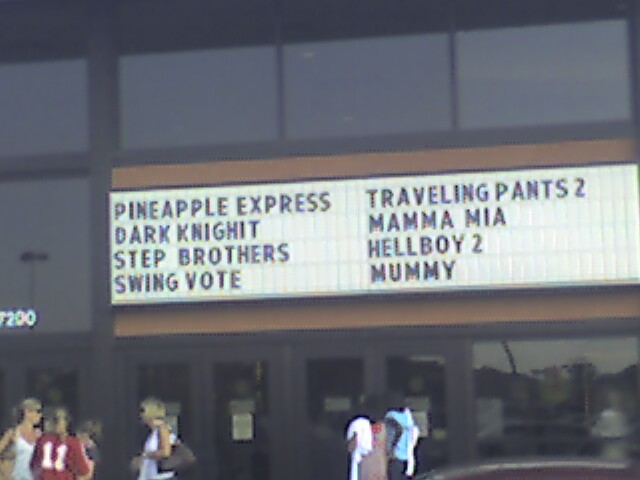
… at the theater is a Monty Python fan. I went out to see “The Dark Knight” and snapped this photo:

bm-image-727756-727792

I can just picture the French taunter taking on Batman … “I fart in your general direction you silly Dark Knighit!” ๐Ÿ™‚

Gotta go … I’m posting this from inside the theater on my Treo and it’s time for the show!

WIJFR: Snow Crash

It is a world where the Mafia controls pizza delivery, the United States exists as a patchwork of corporate-franchise city-states, and the Internet–incarnate as the Metaverse–looks something like last year’s hype would lead you to believe it should. Enter Hiro Protagonist–hacker, samurai swordsman, and pizza-delivery driver. When his best friend fries his brain on a new designer drug called Snow Crash and his beautiful, brainy ex-girlfriend asks for his help, what’s a guy with a name like that to do? He rushes to the rescue.

“Snow Crash” was the first novel I ever read by Neal Stephenson and since earlier this year I finished reading the entire “Baroque Cycle” and then re-read “Cryptonomicon” I decided to re-read “Snow Crash” as well.

When Hiro’s hacker friend Da5id ends up a vegetable after being exposed to a new “drug” called Snow Crash in the Metaverse, he finds himself caught up in plot that involves Sumerian tablets, ancient languages, religious cults, and viruses (both biological and technological). He’ll end up working with the Mafia, the U.S. government, a 15-year old skateboard courier, and his hacker friends against a media mogul, his religious followers, and a crazy brute with poor impulse control and a nuclear warhead in the sidecar of his motorcycle. It’s a fun and fast read.

I read a lot of William Gibson and Bruce Sterling when I was younger, so I was no stranger to cyberpunk, but something was different about “Snow Crash.” Gibson gave us cyberspace, but Stephenson gives us the Metaverse. I also don’t think I ever came across the phrase “neuro-linguistic hacker” in any of Sterling’s work.

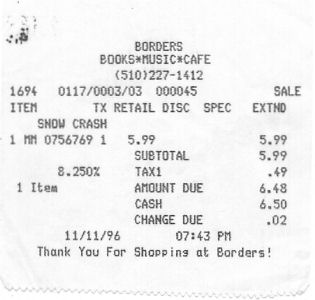
Funny side note: while I reading the book, I came across my purchase receipt, nested in between some pages.

snowcrash-receipt-736069If memory serves, I purchased this book while I was in Pleasanton, CA (hence the 510 area code) at a PeopleSoft training class (I found an old Delta boarding pass with the receipt as well). So it’s been about 12 years since I first encountered Neal Stephenson. His next book, “Anathem” is due to be released this fall.

Know Your Stuff – inventory your home

For years I’ve used the home inventory feature of Microsoft Money to track important items in the house, along with purchase dates, replacement amounts, serial numbers, etc. Even when, starting with Money 2005, it was no longer a supported piece of the application, I continued to use it just because I had so much information in there (and there was no easy way to get it out).

This week I came across a post on Lifehacker pointing to the Insurance Information Institute’s free Know Your Stuff home inventory application and decided to give it a shot. I liked what I saw, so I began the laborious process of manually re-entering all of my home inventory information into Know Your Stuff, copy/pasting from MS Money … but I think it was worth it.

KYS organizes your items by rooms: first you create the rooms of your house, then create the items in those rooms. You enter basic information like the item name, location (room), category, purchase date and price, serial number, descriptive information, etc. You can also attach a photo and/or receipt. Once you’ve done all the data entry, you can generate reports, or even export the data to Excel (in CSV format). If you want a secure, offsite backup solution for your inventory data, KYS integrates with Vault24.

Overall, I like the organization aspect of KYS. It has the flexibility to let me create my own rooms, and even asset types. I like how you can attach multiple photos of a room, but am a little frustrated you can only attach a single picture to an item. Also, for the receipt field, only images are allowed (no PDFs, which would seem to make more sense, especially for multi-page documents). The search function is a bit limited too, allowing you only to search on the item name (instead of say, Make or Model). As for secure backup, I’ll just put a copy of my inventory file in my Amazon S3 account for a lot cheaper than the $15/year fee for storing a single inventory file on Vault24. ๐Ÿ˜›

At least now I’ve got all of that information out of MS Money and into a separate application where I can do better reporting and easier updating.

“WALL-E” is great!

We took my daughter to see Disney Pixar’s latest animated feature, WALL-E, tonight, and it was great. For a film with only a few characters and almost no dialog, it tells a story anyone can follow and understand. It’s not as cartoonish or cutesy as Pixar’s previous fare but will still reach out to all ages (there were several over-55 couples in the theater we went to).

For a box with tank treads and a pair of binoculars stuck on top, WALL-E himself is amazingly expressive. EVE was obviously designed by someone (Jobs?) at Apple with her smooth, white, iPhone-ish appearance (in other nods to Apple, WALL-E’s boot-up sound is the same one used on the Mac, an iPod video makes a cameo, and according to IMDB the voice of AUTO was done by MacInTalk, Apple’s text-to-speech program). My personal favorite was MO, the little cleaning robot who is just trying to keep the Axiom clean despite WALL-E tracking dirt everywhere.

There are plenty of sci-fi references in the film for the older crowd. AUTO, the Axiom star cruiser’s auto-pilot has a HAL-like red eye; Sigourney Weaver is the Axiom’s computer voice; “Also sprach Zarathustra” (also known as the theme from “2001: A Space Odyssey“) is used at one point. I’m sure there were others I missed but there was a lot to take in with just a single viewing.

Oh, and the magic hat/rabbit short at the beginning was hilarious too.

Two thumbs way up … I highly recommend it.