WIJFR: Raven

A young couple necking in Van Cortlandt Park are taken at gunpoint to another location. She is raped while he is tied up in another part of the building. Then the two are put into the trunk of the car and dropped at different locations. The girl is dead…..the boyfriend is charged with murder.

“Raven” is a 1987 crime novel written by Mike Lundy (a pen name of Donald Bain, author of the “Murder, She Wrote” series). This is not my normal genre of reading but I picked up this book 20 years ago at the same library book sale where I got “Mission” so it came to me by random selection. When I was cleaning out my bookshelf and ran across “Mission” and “Raven” I decided to re-read them both.

Fred Raven is a New York City detective who, along with his partner Leroy (Lee) Higgins, is assigned to solve a string of rapes/kidnappings in Van Cortlandt Park. They’re both “good” cops, but aren’t above going slightly above/around/outside the law to get things done. They’re both family men, but aren’t above going outside of their marriages either (let’s just leave it at that ;-)). Their methods are unorthodox, but does that matter if the bad guys are caught? Mixed in with the main storyline are some various tales told (conversationally) by Raven and Higgins of their past cases and how they solved them, which gives the reader a background into their characters.

The book is an easy, straightforward read but be warned there are some graphic scenes and descriptions in it (probably not the kind of thing I should have been reading 20 years ago). Also, it takes place in the 80s so it’s a bit dated: when’s the last time you saw a detective use a pay phone in a bar to call his boss at the precinct?

Side note: four out of my first five WIJFR posts have all been about one-word titled books.

WIJFR: Mission

What would you do if, through an unexpected twist of fate and time, you came face to face with Jesus of Nazareth? In the flesh. A living, breathing, three-dimensional figure with a disconcertingly casual manner. When you had pinched yourself to make sure that you weren’t dreaming and found that he was still there, would you turn your back and walk away – or would you try to find out what he was doing so far from home?

“Mission” by Patrick Tilley has been in my personal library for almost 20 years. I bought it at a used book sale at the Porter Public Library in Westlake, Ohio in the late 80s on a total whim. I can’t remember why my teen-aged self would have purchased it: it’s a nondescript blue and gray hardcover novel, about an inch and a half thick, with no dust jacket, just the words MISSION and TILLEY printed on the spine in gold leaf. There’s no synopsis page in the front, no “about the author” page in the back, nothing to clue my young self into what the book was about. I must have opened it and flipped through a few pages, but I can’t remember what I would have read at the time that made me buy it, but I did. It’s an amazing story, and has apparently turned into a cult classic during the two decades it has sat on my bookshelf …

“Mission” tells the story of Leo Resnick, a Manhattan lawyer who finds himself in the middle of an eternal struggle between cosmic forces of the Power of the Prescence (good) and ‘Brax (evil). And it just so happens that one of the foot soldiers on the ground (Earth) in this war is a Celestial who ends up trapped the body of one Joshua of Nazareth (who we’ve come to know as Jesus). I think “Mission” qualifies as science fiction: there are aliens, space ships, time travel, mystical powers, etc. but it also contains an extremely healthy (and detailed) dose of religion. And not just Judaism and Christianity … all religions. Tilley does a masterful job of weaving his story through history and religion, explaining almost everything in the Bible as we learn the Truth through Leo’s experience with The Man (as he calls him).

I can see religious people possibly being offended with the topic. After all, when it comes down to it, Jesus is a stranded space alien trying to get back home. Tilley also takes a few good shots at organized religion in general. But you have to remember this is fiction: any good story is better when it’s woven into real events (like what the movie “Stargate” did with Egyptian mythology).

In a neat juxtaposition, I started reading this in mid-April, shortly after Easter. So the events in the book were corresponding with current real-life dates and events (at one point, it was May 5 for me and I was reading about May 5 in the book). As with any good book, the twist at the end is the best and made me wish it wasn’t over.

In doing some Google searching while writing this, I’ve learned that apparently this book is now hard to find in-print. I guess I should hang on to my aging first edition for a bit longer … I might want to read it again in another 20 years.

ThrEee weeks later

So it’s been three weeks since I got my Eee PC. Is the honeymoon over? Nope!

I’ve spent the past three weeks carrying (and using) the Eee almost everywhere: taking it to work, having it in the car (in case I’m somewhere with free WiFi), etc. Even now I’m kicking back on the couch watching “CSI” and using it to write this. I’ve pored over the wiki at eeeuser.com, read and posted in the forums (the community there is awesome), and spent time customizing and tweaking the Asus-installed Xandros Linux to my liking. Thus far I’ve:

  • upgraded to 1gb of RAM: it took me longer to order the 1gb DDR chip than it did to actually install it (see here for a video of just how easy it is).
  • customized the interface: using tools like Theeemer, Tweakeee, and EMEditor, I’ve changed the default look-and-feel to something a little slicker looking (see the screen capture at the top of this post).
  • installed more applications: I’ve got TrueCrypt so I can access the encrypted volume on my thumb drive, JungleDisk to get to my files backed up with Amazon’s S3 service, and Maelstrom for a little entertainment.
  • configured it for work purposes: using the PPTP Client I can VPN into the corporate network and then login to my servers with rdesktop or run applications through Citrix.
  • gotten pretty good at accurately typing on the keyboard
  • played around with eeecontrol: this utility lets you increase the front-side bus speed (and thus get the CPU back to its normal 900MHz speed instead of the Asus-underclocked 630MhZ). I really haven’t had a problem with the Eee’s performance so I’ve left it alone for now. I still run eeecontrol in the tray, though, so I can watch the fan speed and temp.

It wasn’t all smooth, though. I had a real problem initially getting onto my wireless home network. It turned out that the default wireless driver/script doesn’t like spaces in the WPA key. Once I removed the spaces, the Eee connected just fine (and then I had to fix the WPA key on every other wireless device on the network). After that, I still had problems connecting to the wireless at work (which also uses WPA). Switching to the madwifi driver seemed to finally help in that regard (though I still get the dreading “Pending” status now and then).

The other difficulty was getting wireless printing to my Epson AcuLaser CX11NF working. The test page would “print” according to the Eee, but nothing would happen on the printer. It took some research, but I finally got it working (see my thread on the eeeuser forum for details).

My other minor nit is with the screen size. The 800×480 resolution means sometimes having to drag windows around with the Alt-left click trick in order to see portions that won’t fit on the screen. This also means that web sites that are designed for larger resolutions (like my daughter’s WebKinz site which is all Flash) involve a lot of dragging back and forth.

Overall, I’m pretty happy with my Eee. Asus has come pretty close to a hitting a home run with the cost, form factor and out-of-the-box usability. The new 900 model adds the 9″ screen with a slightly larger footprint but at the cost of a slightly larger price tag, so the original 701 series still seems like the better deal that hits the sweet spot.

(more photos of my Eee are posted here)

WIJFR: Redwall

Matthias, a mouse of Redwall Abbey, is in trouble, as are the rest of the mice. When Cluny the Scourge attacks Redwall with his horde, Matthias goes on a quest to retrieve the sword of Martin the Warrior, which he believes will give victory over the evil vermin.

My daughter and I just finished reading Brian Jacques’ “Redwall.” the first book in his 20-year old Redwall series. I read a lot of science fiction and fantasy as a child so I’m not quite sure how I never came across this saga until now. I think I heard about it mentioned casually on a podcast a few months ago and thought, now that my daughter had finished the Harry Potter books, it sounded like a good series to challenge her with (she’s in first grade) and something we could read and enjoy together. So we spent the past month reading a few pags a night …

All of the characters in “Redwall” are animals: mice, moles, badgers, rabbits, and other woodland creatures are the good guys, and the bad guys are the rats, weasels, ferrets, stoats, snakes, foxes, etc. You can see how the good/evil theme moves on from there. The mice are peaceful and share the bounty of the land with their fellow creatures at Redwall Abbey. The rats, led by Cluny the Scourge, are power-hungry and want to pillage, plunder, and loot. To save the abbey and his friends, Matthias must go on a quest to find the legendary sword of Martin the Warrior, the previous champion defender of Redwall.

It was a relatively easy read: some of the chapters were just a few pages, which made for a nice quick skim before bedtime. There are a lot of “dark” subjects though, particularly murder, that I was a little concerned about reading with a 7-year old. Like I mentioned though, she’s read all the Harry Potter books so she’s been exposed to those topics before. I did learn, though, to not necessarily end the bedtime reading on a Cluny chapter.

Since we had so much fun reading the first one, I’ve already ordered the next four in the series. We’ve got our daddy/daughter reading material set for the summer. Next up, “Mossflower.” Want to know more? Check out the Redwall Wiki.

My Eee PC

I’ve been following Asus’ Eee PC since it was first released late last year and was finally no longer able to resist its siren call. I purchased the Galaxy Black 4G Surf, deciding that the extra $50 over the 2G Surf was worth a) double the storage capacity (4gb vs. 2gb), b) user-upgradeable RAM, and c) a slightly faster CPU (you can see the model comparisons here).

My initial observations:

  • It’s tiny! The photo to the left shows the Eee on top of my Sony VAIO SZ340P. Of course, with the smaller size comes a few compromises: the 7″ screen doesn’t give you a lot of real estate and the keyboard is a bit cramped for my big hands. When at home, these problems could be solved by connecting an external monitor, keyboard, and mouse, but that would diminish the coolness factor of how small it is.
  • It’s quiet. No moving parts except for the fan (and I haven’t heard that kick on yet).
  • It’s fast (but not too fast). The 4G Surf uses a 900 MHz Intel Celeron M processor (but it’s underclocked to just 630 MHz!) and has 512mb of RAM. The system boots the customized Xandros Linux distro from the solid-state hard drive in just a few seconds and seems snappy enough even with a few applications open.

I haven’t had a lot of time to play with it yet, but I’ll post my observations here as I learn more about it. On my To Do List is “over”-clocking the CPU back to 900MHz, possibly upgrading to 1gb or 2gb of RAM, and possibly attempting to install Windows XP. Check back later for more!

WIJFR: A Princess of Mars

Ex-confederate army captain John Carter finds himself unwittingly transported to Mars, while fleeing Apache Indians. This new world is populated by a race of monstrous Martians, whose culture is based on the ability to fight for their race. Fortunately for John, the gravitational difference between Mars and Earth has endowed him with the strength that he will need for survival on this hostile planet. John Carter battles ferocious Martian creatures, but gains the respect and friendship of the Barsoomians. He also encounters the beautiful Dejah Thoris, Princess of Helium, and earns her everlasting devotion.

Technically I just finished listening to Edgar Rice Burroughs’ “A Princess of Mars” thanks to a free download from audible.com. A neat feature of audio books (at least on my iPod) is the ability to change the speed of the playback. Thus, I was able to “read” the entire book in just a few commutes back and forth to work this week.

I knew, in the back of my mind, that this was classic science fiction, but I had no idea just how old it actually was. Burroughs wrote this first story in his Mars series in 1911, before “Tarzan of the Apes.” So it wasn’t exactly the classic SF I’m used to (like that of Asimov, Bradbury, or even Wells), but more of a pulp sci-fi novel (just check out some of the cover art to see what I mean).

It’s a tale of adventure, swashbuckling, and romance as Virginia gentleman John Carter is mysteriously transported to the red planet and fights to survive amidst the green and red “men” of Mars. He learns their language, their customs, and eventually, their loyalty (no more spoilers here).

While I enjoyed listening to this first of the series (again, it was a free download), I’m not sure I liked it enough to pursue the remaining books (at least, not now). Maybe some time, though, I’ll return to this classic series to see just what John Carter, Dejah Thoris, and the other Barsoomians get into.

WIJFR: Next

I do a lot of reading and figured I would write up some quick reviews here as I finish a book … here’s my first WIJFR (What I Just Finished Reading) post.

Is a loved one missing some body parts? Are blondes becoming extinct? Is everyone at your dinner table of the same species? Humans and chimpanzees differ in only 400 genes; is that why a chimp fetus resembles a human being? And should that worry us? There’s a new genetic cure for drug addiction–is it worse than the disease? What’s coming Next?

So I just finished reading “Next” by Michael Crichton and have to say I was slightly disappointed. This is the second Crichton novel that has underwhelmed me (the last book I read by him was “Prey“). Maybe it’s because the science wasn’t science-fictiony enough for me (like “Jurassic Park” or “Timeline“), or maybe it was just that there were so many different story lines that got tied up way too quickly (almost abruptly) in the end.

The underlying theme of “Next” is genetics and it does raise some interesting topics including gene patents, tissue ownership, genetic engineering, and transgenic animals. Off the top of my head I can recount seven separate story lines and their associated cast of characters (some human, some transgenic animal like Gerard the African Grey parrot or Dave the humanzee). It just seemed too busy and crowded. Peppered in between chapters are news articles and clippings on various genetics topics (like “Blondes will be extinct in 200 years!”). For the first half of the book I was wondering if any of these threads were going to intersect and what exactly the plot was. Eventually everything comes together, but by that point you’re on the last few chapters (hence my feeling of an abrupt ending).

Despite all of that, it was an easy, relatively quick read, and it certainly hasn’t turned me off to Crichton’s work (he’s had me hooked since “The Terminal Man” and “The Andromeda Strain.”

On Amazon’s page for this book I found a link to NEXTgencode, a website tie-in to the book that tries to look real and references a lot of the genetic products talked about in the book (check out the PermaPuppy!).

Palm Treo 650

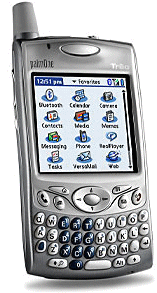
Palm Treo 650After starting out in the Palm camp back in 1996, then switching to Pocket PC and hp’s iPAQ line in 2001, I’m now a Palm user again. I got a Palm Treo 650 through work, and I love it … finally I don’t have to carry my PDA, cell phone, and G100 (e-mail device). I’ve got all three in a small, cellphone sized package.

hp iPAQ h1945

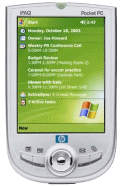
hp iPAQI’m a long-time PDA user. I got my first Pilot 1000 back in 1996, then eventually upgraded to the Palm III. Over the summer of 2001 I left the Palm world for the Pocket PC, or Windows Mobile as it’s referred to now. My first iPAQ was the 3135 (black-and-white version) and then I inherited an older color 3760 model from a colleague.

Currently I have the hp iPAQ h1945, which is smaller and cooler than any PDA I’ve had before. The high-resolution, 64,000 color screen is still the best in the industry, it runs Windows Mobile 2003, and has built-in Bluetooth connectivity. The newer iPAQs forgo the old expansion sleeves (to add on Compact Flash support) for an integrated Smart Media slot (which I’ve never used, actually). This means I don’t really have a need for my IBM MicroDrive anymore, but oh well … it’s not the first time I’ve bought something for the “cool” factor and then never used it. 🙂